Closing the Gender Retirement Gap: How Financial Wellness Can Help

Closing the Gender Retirement Gap: How Financial Wellness Can Help

Closing the gender retirement gap: How financial wellness can help. Female employees still face workplace disparity when it comes to retirement planning. Here’s what employers can do to close the gender retirement gap. 

Despite progress toward gender equity in the workplace, women still face disparities in retirement preparedness. Men have about 40% more income than women during retirement, according to the OECD, and this trend isn’t limited to the U.S. In fact, nearly every retirement system in the world suffers from the gender retirement gap.

Find out how the gender retirement gap affects your employees, and how financial wellness and other strategies can help level the playing field.

What is the gender retirement gap?

The gender retirement gap refers to the difference in retirement preparedness between men and women — it largely stems from the gender wage gap. According to data from the Center for American Progress, white women earn only 79 cents for each $1 earned by white men. Race furthers this disparity, with Black and brown women earning only 60 cents.Preparing for retirement takes years of saving. So, lower wages earned for an entire career compound into significant differences in retirement preparedness.

How to fix the gender retirement gap:

Employers can help bridge the gender retirement gap; however, doing so requires dedication to employee financial wellness and equity. 

While there is no fix-all solution, here’s 3 ways to help join the gender retirement gap:

 1. Extend flexibility and family leave to parents of all genders

Women are more associated with time away from the office, especially when it comes to childrearing and the home. Under federal law, employees are only guaranteed 12 workweeks of unpaid family medical leave; however, the loss of income can be detrimental to household finances.

With little federal guidance, employees must depend on their employers’ leave policy.

Parental leave policies typically give women substantially more time off than men, and for most women, their leave is unpaid. Less than 25% of employees receive paid parental leave, according to BLS data, and they typically receive only a percentage of their original paycheck. 

When thinking about family leave policies, consider birthing and non-birthing parents and how each may need support. Some companies allow flexible or hybrid work hours, which allow working moms to gradually re-enter the workforce. Others offer family leave of at least six weeks to both, so it’s easier to balance and share home duties.

2. Address career differentials by gender to avoid wage gaps

Since women take on more part-time and unpaid work than men, overtime, this accumulates to women spending less time in the workforce than men. On average, women spend nine fewer years in the workforce, which can hurt women’s pay and promotional opportunities. Less money now means even less during retirement. 

Pension plans often require a minimum salary or hours worked for pension payouts. This lessens retirement security for low earners and part-time workers, who are disproportionately women. 

Take an honest, critical look at your company and see how you may overlook employees on leave during promotions and bonuses. This can help create equal opportunities for men and women to advance their careers and pay — which may mean reforming employee skills matrices to be more inclusive of those who take leave. Employees should never feel penalized or professionally stagnated for taking time off. 

3. Offer employee financial wellness resources and education

Women, on average, are less financially literate than men. When quizzed on personal finance, 21% of women exhibited a relatively low level of financial literacy, compared to 15% of men, according to the TIAA Institute. And when looking at specific financial topics, like investing, the financial literacy gap only widens. Gaps in financial knowledge, such as these, can enlarge the gender retirement gap.

Researchers also think the gap could be explained by women spending more income on the home (e.g., groceries, daycare and cleaning) than they do on retirement or themselves. 

Nonetheless, as a solution, experts at Mercer have advocated for financial wellness to help close the gender retirement gap. Through financial wellness programs, women can receive personalized money coaching and other tools to increase their overall financial preparedness. 

A major perk of financial wellness programs is that their personalization helps employees of all income brackets and ages. From fresh post-grads, to even those close to retirement, all can benefit from financial wellness resources and guidance — they are to help people achieve their financial goals, while dialing down financial stress. 

Need a financial wellness solution? Try Best Money Moves!

Best Money Moves can help your employees address their financial stress and become prepared for retirement, regardless of their stage in life or previous money habits. Best Money Moves offers personalized financial wellness resources and education, focused on solving your employees’ pain points. The program uses artificial intelligence and a human-centered design to measure employee financial stress and then dial it down with personalized solutions. Our budgeting tools, personal finance guidance and more helps employees make more informed financial decisions and reduce their overall stress.

To learn more about Best Money Moves Financial Wellness Platform, let’s schedule a call. Contact us and we’ll reach out to you soon.

4 Family-Friendly Benefits to Support Employees

4 Family-Friendly Benefits to Support Employees

4 family-friendly benefits to support employees. Work-life balance is an important focus for workforces. Consider these 4 family-friendly benefits to support employee growth and financial wellness. 

Employers are investing in the work-life balance, with a keen focus on supporting families. About 60% of U.S. employers say family-friendly benefits have been critical to their talent strategy, according to a Willis Towers Watson survey.

Family-friendly financial benefits aim to support employees at all stages of their family-planning journey, from adoption and conception to planning for the family’s future. Here are 4 family-friendly benefit options for your team.

4 family-friendly benefits to help support families at any stage

 1. Accessible fertility benefits

About 60% of employees said that family-forming and fertility issues have impacted their work performance, according to the National Infertility Association, and 77% said they’d stay with their employer at their company longer if fertility benefits were offered. 

Fertility benefits enable all employees — regardless of gender, sexual orientation, relationship status or physical health — the opportunity to build a family. 

Common fertility benefits, per the International Foundation of Employee Benefit Plans (IFEBP), include:

  • Fertility medications
  • In vitro fertilization (IVF) treatments
  • Visits with health counselors (e.g., surrogacy advisors)
  • Genetic testing

Almost 25% of employers offer fertility medications and IVF treatments to employees. More expansive plans are emerging with egg freezing and non-IVF fertility treatments. 

Fertility benefits can foster an inclusive and equitable workplace and approach to family, particularly for LGBTQ+ employees and single prospective parents.

 2. Equally accessible benefits options for adoption

Fewer employers offer benefits for adoptive parents; however, this is changing. Almost 30% of employers offer paid adoption leave, which `gives adoptive parents time to bond with their children of any age, according to the Society for Human Resource Management (SHRM). Other employers have also introduced foster leave. 

Adoption reimbursement and other financial assistance are also gaining traction. The cost of adoption can be thousands, and ultimately present a financial barrier to family building and security. Employers can equitably support employees looking to adopt by helping remove any barriers to a successful adoption.

Moreover, studies have shown that adoption benefits improve employee loyalty and retention at companies, even for employees who do not intend on using the benefits themselves. This is because just by offering adoption benefits, the employer is viewed as sensitive and caring, to even the most personal employee needs.

 3. Parental leave, beyond the federal minimum

Under federal law, employees are only guaranteed 12 workweeks of unpaid family medical leave; however, this only applies if their employer is a public organization or company with 50+ employees. For many, this isn’t enough. Many families cannot afford unpaid leave, causing many women to choose between caregiving and work.

And women choose caregiving, in mass numbers. Between 2020 and 2021, over 2.3 million women have exited the workforce, dropping the women participation rate to historic lows since 1988, a SHRM report said.

To support the work-life balance of all employees, companies started offering their own parental leave policies beyond the federal minimum, according to SHRM, such as:

  • Paid maternity leave, including family/parental leave (53%) 
  • Paid paternity leave, including family/parental leave (44%)
  • Paid parental leave (39%)

Rather than only focusing on leave for birth-giving parents only, parental leave is to support birthing and non-birthing parents of all genders. In addition, paid leave, even if it’s a percentage, can help alleviate income loss and financial stress.

4. Family-friendly financial wellness resources to aide in family planning from start to finish

Pre- and post-pandemic economics have caused deep financial stress, and financial stress looks different from family-to-family. For some, it is planning for retirement, while for others, it’s budgeting for daycare, which can cost upward of $1000 a month. Nonetheless, employees are looking for financial wellness resources to support their family and financial goals, at all stages of life.

More than half of millennial parents say that kids are more expensive than they thought, according to a Bank of America report. Budgeting and calculating resources can help assess the true cost of family expansion, especially for first-time parents. 

More than 60% of Americans live paycheck to paycheck, according to a recent LendingClub report. And almost half find it difficult to pay their monthly bills on time, according to PwC. So, for some families, their financial goal is to simply live within their means. Others may focus on saving for a newborn, college or retirement. Regardless of the financial issue, the best financial wellness resources personalize their solutions to each employees’ needs.  

Looking for a family-friendly financial wellness solution fit for all? Check out Best Money Moves.

Best Money Moves is a financial wellness solution designed to help dial down employees’ most top-of-mind financial stresses. As a comprehensive financial wellbeing solution, Best Money Moves offers 1:1 money coaching, budgeting tools and other resources to improve employee financial wellbeing. Our AI platform, with a human-centered design, is easy to use and fit for employees of any age. 

Whether it be college planning or securing a mortgage, Best Money Moves can guide employees through the most difficult financial times and topics. Our dedicated resources, partner offerings and 700+ article library makes Best Money Moves a leading benefit in bettering employee financial wellness. 

To learn more about Best Money Moves Financial Wellness Platform, let’s schedule a call. Contact us and we’ll reach out to you soon.

DEI & Financial Wellness: Bridging the Retirement Race Gap

DEI & Financial Wellness: Bridging the Retirement Race Gap

DEI & Financial Wellness: Bridging the retirement race gap. Learn how the retirement race gap affects your workforce, and how your company can prevent retirement insecurity by addressing it head-on.

According to a report by Morgan Stanley, white retirees have seven times the retirement savings of Black retirees, and five times the retirement savings of Latinx retirees, at work. Employers can help bridge the race gap. Start with a focus on employee financial wellness and equity.

What is the retirement race gap?

The retirement race gap is the disparity in retirement preparedness between Black Americans and Americans of color, and their white counterparts.

The retirement gap is fueled by inequality in the workplace

Black and Latinx employees are paid 26 to 39 cents less for every dollar that white employees make. However, when you factor in gender and race, Black and Latinx women are the least prepared and secure for retirement. For each $1 earned by white men, Latinx and Black women make 57 and 64 cents, respectively.  

The racial wage gap often leads to the retirement race gap because earning less over one’s entire career stifles growth and security into retirement. Companies can address these disparities by taking a deeper look at their own equity and compensation practices.

How to close the retirement race gap, while improving financial wellness and DEI

Research from T. Rowe Price suggests that the workplace is where most employees look for advice for their lifetime financial goals, and this is equal across races. However, the level of financial stress and support differs across races, and the trend continues well into retirement. Companies can support employees’ financial goals and disrupt inequality by addressing the retirement race gap. Moreover, doing so prioritizes employee financial wellness with a DEI approach.

1. Set fair, equitable hiring practices and promotion opportunities

Whether it be name bias or stereotyping, hiring discrimination helps concentrate people of color into jobs and industries less likely to offer retirement benefits. In such industries — accommodation, food and waste — less than 40% of workers are offered retirement benefits, according to Dr. Nari Rhee from UC Berkeley.

Companies can help close the retirement race gap by offering unconscious bias training and analyzing how it affects the hiring process. Some employers have taken it a step further and require applicants of color to be interviewed for all internal and external positions.

2. Host company incentives, like match contributions, to encourage benefits use

Events, contests and webinars can be an easy way to encourage employees and teach them about 401(k) tax benefits. A leading incentive that enhances employee engagement and loyalty is a match contribution program. Employees often see match contributions as an investment in themselves and their financial futures. And knowing retirement funds will be matched, employees are increasingly motivated to save.

3. Add financial wellness programs and education to employee benefits

Employees have different levels and causes of financial stress, so naturally, they each have different financial goals. Financial wellness programs can offer personalized help to address employees’ most pressing financial stress. Whether through 1:1 coaching and detailed calculators, financial wellness programs can help employees develop financial literacy and confidence, as well as money management skills.

4. Address the retirement race gap head-on and use 401(k) auto-enrollment to increase participation

If you already offer retirement benefits, consider auto-enrollment for all employees. Studies show that auto-enrollment substantially increases employee participation because employees are unlikely to opt out. Once enrolled, employees will likely make an effort to educate themselves on 401(k)s and contribute, and employers can facilitate such learning.

5. Track progress and revisit company goals annually

Closing the retirement race gap will not happen overnight; however, with continuous work and dedication, companies can curtail the wealth disparity. Keep track of company progress and engage employees for feedback — see how new initiatives work, and what old practices may need revisiting. It’s important to check in annually to take stock of progress made and opportunities for change.

Looking for a financial wellness solution? Consider Best Money Moves.

Best Money Moves can help your employees address their financial stress and become prepared for retirement, regardless of their stage in life or previous money habits. Best Money Moves offers personalized financial wellness resources and education, focused on solving your employees’ pain points. The program uses artificial intelligence and a human-centered design to measure employee financial stress and then dial it down with personalized solutions. Our budgeting tools, personal finance guidance and more help employees make more informed financial decisions and reduce their overall stress.

To learn more about Best Money Moves Financial Wellness Platform, let’s schedule a call. Contact us and we’ll reach out to you soon.

4 Reasons to Care About Employee Financial Wellbeing

4 Reasons to Care About Employee Financial Wellbeing

4 reasons to care about employee financial wellbeing. Thanks to the pandemic, employee financial wellbeing is a huge point of focus for many workforces. Here’s why that should matter to your team.

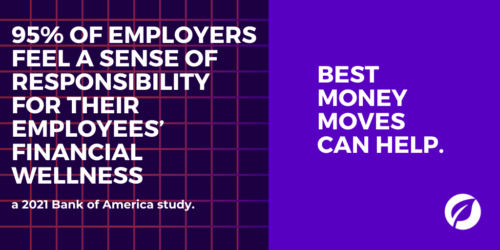
According to a 2021 Bank of America study, 95% of employers feel a sense of responsibility for their employees’ financial wellness. Indeed, employee financial wellness is the new normal for organizations — and for good reason. Financial stress has far reaching effects far beyond an employee’s wallet, impacting everything from productivity, to mental health and even retention.

Here are 4 reasons why financial wellbeing is a must-have in your employee benefits package.

1. Financial stress lowers employee productivity.

More than 60% of employees say that their financial stress has increased since the onset of the COVID-19 pandemic, according to a PwC survey. And that financial distress can easily seep into an employee’s work life and disrupt job performance. 

In the same PwC survey, employees whose financial stress increased due to the pandemic were four times more likely to admit that finances are a distraction at work. And over time, long-term stress can lead to health issues, burnout and potential resignations.

Investing in financial wellness benefits can support employees’ overall wellness and help them focus while at work. More than 80% of employers agreed that financial wellness programs lead to greater employee engagement and productivity.

2. Focusing on financial wellbeing and financial wellness  can promote retention and attract new talent.

Financial stress, burnout and other COVID-19 related factors have contributed to widespread resignations at a higher-than-usual rate, also known as “the Great Resignation.” Offering financial wellness benefits is a way to support existing and future employees during this uncertain time — and employees recognize this as well.

Employees have shown a preference for companies who are invested in their financial wellbeing. A PwC study showed that most employees would consider leaving their current employer, if they came across another that cares more about their financial wellbeing. 

Again, financial wellbeing impacts much more than just employees’ pockets — it impacts health, stability and security, too. So, making financial wellness an integral part of overall wellness can go a long way with both future and existing employees.

3. Financial wellbeing is tied employee mental health more than you think.

COVID-19 has made both employees and employers reconsider their approach to mental health. In addressing employee wellbeing and providing support, employers must take a comprehensive approach and consider financial wellbeing, as well. 

Money reaches all aspects of life — family, home, work and personal health — and it has a huge effect on overall wellbeing. Financial stress and its effects do not function in a silo. In fact, a third of employees said their mental health negatively affected their job performance in 2021, per an Aflac report. 

Whether worrying about bills or retirement, financial stress can cause depression and anxiety, especially amid long-term uncertainty like a pandemic. Half of American employees have high anxiety about health care costs beyond what their insurance covers. And more than a quarter of the U.S. workforce currently describes itself as “depressed,” says a Gartner HR survey.

The more support employers can offer, the better, and a tangible form of support is financial wellness benefits. It can foster employee satisfaction and improve wellbeing.

4. Employees need more financial benefits than retirement and student loan assistance

Financial wellness is an all-encompassing benefit that applies to all employees in some way. Not everyone has the same financial goals, especially within a multigenerational workforce. Financial wellness takes a more personalized approach, it allows employees to address the financial goals and stress that matters most to them.

Older employees may not be attracted to student loan benefits, whereas some millennials may not utilize retirement plans. Over 80% of employees want personal finance benefits and guidance beyond typical retirement plans and safety net insurance. This mismatch in offered benefits and employee needs often causes offered benefits to go used.

Instead, by offering financial wellness programs, like Best Money Moves, employers can help employees manage their personal finance goals and stress. 

Best Money Moves is a mobile-first platform that offers personalized financial planning and coaching resources, focused on solving your employees’ pain point. The program uses artificial intelligence, along with a human-centered design, to measure employee financial stress and then dial it down with personalized solutions. Our triggers and alerts system — as well as budgeting tools, personal finance resources and more — help guide employees to make more informed financial decisions and reduce their overall stress.

To learn more about Best Money Moves Financial Wellness Platform, let’s schedule a call. Contact us and we’ll reach out to you soon.