
4 Reasons to Care About Employee Financial Wellbeing

4 Reasons to Care About Employee Financial Wellbeing

4 reasons to care about employee financial wellbeing. Thanks to the pandemic, employee financial wellbeing is a huge point of focus for many workforces. Here’s why that should matter to your team.

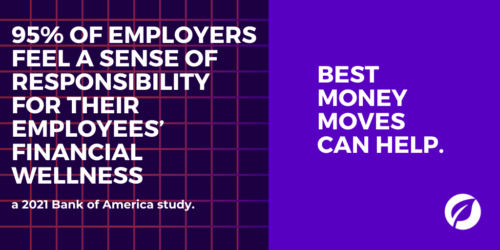
According to a 2021 Bank of America study, 95% of employers feel a sense of responsibility for their employees’ financial wellness. Indeed, employee financial wellness is the new normal for organizations — and for good reason. Financial stress has far reaching effects far beyond an employee’s wallet, impacting everything from productivity, to mental health and even retention.

Here are 4 reasons why financial wellbeing is a must-have in your employee benefits package.
1. Financial stress lowers employee productivity.

More than 60% of employees say that their financial stress has increased since the onset of the COVID-19 pandemic, according to a PwC survey. And that financial distress can easily seep into an employee’s work life and disrupt job performance. 

In the same PwC survey, employees whose financial stress increased due to the pandemic were four times more likely to admit that finances are a distraction at work. And over time, long-term stress can lead to health issues, burnout and potential resignations.

Investing in financial wellness benefits can support employees’ overall wellness and help them focus while at work. More than 80% of employers agreed that financial wellness programs lead to greater employee engagement and productivity.

2. Focusing on financial wellbeing and financial wellness  can promote retention and attract new talent.

Financial stress, burnout and other COVID-19 related factors have contributed to widespread resignations at a higher-than-usual rate, also known as “the Great Resignation.” Offering financial wellness benefits is a way to support existing and future employees during this uncertain time — and employees recognize this as well.

Employees have shown a preference for companies who are invested in their financial wellbeing. A PwC study showed that most employees would consider leaving their current employer, if they came across another that cares more about their financial wellbeing. 

Again, financial wellbeing impacts much more than just employees’ pockets — it impacts health, stability and security, too. So, making financial wellness an integral part of overall wellness can go a long way with both future and existing employees.

3. Financial wellbeing is tied employee mental health more than you think.

COVID-19 has made both employees and employers reconsider their approach to mental health. In addressing employee wellbeing and providing support, employers must take a comprehensive approach and consider financial wellbeing, as well. 

Money reaches all aspects of life — family, home, work and personal health — and it has a huge effect on overall wellbeing. Financial stress and its effects do not function in a silo. In fact, a third of employees said their mental health negatively affected their job performance in 2021, per an Aflac report. 

Whether worrying about bills or retirement, financial stress can cause depression and anxiety, especially amid long-term uncertainty like a pandemic. Half of American employees have high anxiety about health care costs beyond what their insurance covers. And more than a quarter of the U.S. workforce currently describes itself as “depressed,” says a Gartner HR survey.

The more support employers can offer, the better, and a tangible form of support is financial wellness benefits. It can foster employee satisfaction and improve wellbeing.

4. Employees need more financial benefits than retirement and student loan assistance

Financial wellness is an all-encompassing benefit that applies to all employees in some way. Not everyone has the same financial goals, especially within a multigenerational workforce. Financial wellness takes a more personalized approach, it allows employees to address the financial goals and stress that matters most to them.

Older employees may not be attracted to student loan benefits, whereas some millennials may not utilize retirement plans. Over 80% of employees want personal finance benefits and guidance beyond typical retirement plans and safety net insurance. This mismatch in offered benefits and employee needs often causes offered benefits to go used.

Instead, by offering financial wellness programs, like Best Money Moves, employers can help employees manage their personal finance goals and stress. 

Best Money Moves is a mobile-first platform that offers personalized financial planning and coaching resources, focused on solving your employees’ pain point. The program uses artificial intelligence, along with a human-centered design, to measure employee financial stress and then dial it down with personalized solutions. Our triggers and alerts system — as well as budgeting tools, personal finance resources and more — help guide employees to make more informed financial decisions and reduce their overall stress.

To learn more about Best Money Moves Financial Wellness Platform, let’s schedule a call. Contact us and we’ll reach out to you soon.

4 Ways Financial Wellness Can Boost Employee Retention

4 Ways Financial Wellness Can Boost Employee Retention

4 ways financial wellness can boost employee retention. Retention is an increasing problem in the post-COVID workforce. Financial wellness benefits could be the solution employers need. 

In the post-COVID world, retention is an increasingly complex problem that organizations are struggling to solve. 

In fact, 64% of American workers are seeking or considering new employment according to a November 2020 study by HR software firm Ceridian. That number jumps to 75% for workers under 30. For organizations to have any hope of combatting this wave of turnover, they need to first get real about the pain points driving employees to leave. That’s where financial wellness comes in. 

Consider these four ways that financial wellness benefits can help boost employee retention.

1. Financial stress is a bigger problem than most employers realize.

Vaccinations have significantly improved the state of the pandemic, but experts estimate that it could take years for Americans to recover financially. Now, most Americans rank their finances as the single biggest source of stress in their life. Finances can be a taboo topic at work, but chances are you have multiple team members that are struggling. Offering financial wellness benefits can provide valuable help to employees of all ages, incomes and backgrounds. 

2. Financial wellness provides tangible benefits to stressed employees — and their workforces.

Financial stress can lead to a loss of productivity, increased absenteeism and widespread mental health challenges among employees. So, learning how to manage your money doesn’t just reduce stress in an abstract sense. When employees are less stressed about money, they’re more focused at the office and spend less time on non-work related issues. This, in turn, can reduce absenteeism and improve overall retention rates.

3. Financial wellness programs can help employees feel seen by their employers.

When you offer financial wellness programs to your employees, you signal to them that you care and have a realistic view of their work/life balance. Staying connected with the struggles of your employees helps create a more intimate work culture, which in turn creates a more positive overall experience at the office and makes it that much harder to leave.

4. Money impacts every aspect of your employees life. Financial wellness can too.

At its core, retention is about ensuring employee satisfaction and successful retention strategy finds a way to help employees feel fulfilled in all areas of their lives. Money touches nearly every aspect of a person’s life, from daily spending, to housing, to family planning, or saving for a future retirement. So financial wellness can bring wide-reaching, impactful help to employees at any stage or circumstance.

Best Money Moves is a human-centered and individualized approach to financial wellbeing. The comprehensive and user-friendly platform provides a plethora of financial resources and educational tools. The library of resources contains over 700 articles, videos, and calculators. Each Best Money Moves user has their personal feed tailored to the several distinct factors that monitor their personal stress. This means your employee can use Best Money Moves to educate themselves on anything from investing in the stock market to co-signing loans to buying their first home. 

Employee information is always private but employers do have access to key analytics that show overall employee financial stress and stress levels over time. The Employer Dashboard also features information on program usage, debt and savings levels and more so employers can see just how valuable Best Money Moves is to their employees.

If you want to learn more about how Best Money Moves can bring financial wellness to your company, download our whitepapers.

4 Ways to Support Female Team Members After COVID

4 Ways to Support Female Team Members After COVID

4 Ways to Support Female Team Members After COVID. Research increasingly finds that women have been disproportionately affected by the pandemic. What can employers do to support female team members? 

Women, especially women of color, have been disproportionately impacted by the COVID-19 pandemic. According to a 2020 study conducted by McKinsey & Company, women comprise roughly 39 percent of global employment, but have accounted for 54 percent of all pandemic-related job losses. 

Even as the pandemic wanes, many women continue to face long-term hurdles to their career development due to inaccessible childcare options or gaps in their work history from forced time off. What can employers do to provide better support to these female team members? 

Consider these 4 benefits that can help provide much needed support to women in your post-pandemic workforce. 

1. Facilitate flexibility for all employees.

It comes as no surprise that many women with families are still the primary caregivers in their homes. In fact, according to research from the Society of Human Resource Management, as many as one in five people know a woman who left the workforce during the pandemic in order to handle child care that became suddenly inaccessible after daycares and schools closed.

Consider pivoting your team to a results-focused rather than time-focused schedule. This can not only support productivity, but also keep workers less stressed and more focused as they know they have support for their duties both at work and at home. 

2. Provide paid parental leave for new parents, regardless of gender.

Similarly, if your workers are welcoming a new family member as part of the anticipated post-COVID baby boom, aim to provide mothers and fathers alike with paid parental leave. According to a report from the U.S. Bureau of Labor Statistics, only 21% of US workers have access to paid family leave through their employers. This puts the U.S. well behind any other wealthy country, where paid parental leave is not only available, but often nationally mandated.

Paid parental leave has been shown to help combat income inequality and improve job continuity, especially for lower-income families. Plus, providing leave to men in addition to women normalizes the practice and combats the “motherhood” bias. This is a prejudice that women may face in competitive fields should they choose to take time off work to be with their new children.

3. When hiring new team members, be realistic about the gaps in work history related to the pandemic.

For those women forced out of the workforce by the pandemic, returning to the office may not be as simple as picking up their careers where they left off. Even as they return to work, many women fear long-term damage to their career trajectory and salaries, which have been thrown off track by the unexpected absence. When approaching the hiring process after COVID, try not to penalize applicants who may have been forced to take time off work due to the pandemic. 

4. Institute (and stick to) pay equity measures among team members.

Finally, and perhaps most importantly, be sure that you compensate your female workers with the same criteria you use to compensate male employees. On average, white women still earn only 79 cents to every dollar that their male coworkers earn for the same positions. Women of color are often even more significantly impacted, earning anywhere from 54 to 62 cents on the dollar compared to white men.

One idea some companies are using to successfully address this issue is to conduct transparent salary audits. This holds the company accountable and signals to potential employees that there is an active effort to achieve equity. Another successful strategy is banning inquiries about past salaries. This effort stops employers from importing unequal salaries from past companies.

Gender equality benefits all employees in your organization. Be sure to review and update your strategy for gender parity often to make sure you’re supporting the team members who may need it most.

If you want to learn more about how Best Money Moves can bring financial wellness to your company, download our whitepapers.

The Top 5 HR Trends to Look For In 2021

The Top 5 HR Trends to Look For In 2021

The Top 5 HR Trends to Look For In 2021. Keep an eye out for these five up-and-coming HR trends as workforces everywhere adjust to a post-COVID world. 

It’s no secret that 2020 was a disruptive year. Fallout from the Coronavirus/COVID-19 pandemic forced millions of Americans to work from home, and changed the way employers think about employee wellness. The new workforce needs to be adaptable and resilient in the face of uncertainty and leadership must find new ways to keep their teams motivated and healthy. 

 Here are the top 5 HR trends to look for in 2021, after a year that transformed the way Americans work. 

  • Continued remote work & an emphasis on hybrid work spaces. 

A year into the pandemic, workers have had time to reflect on the pros and cons of going remote and, to the surprise of many, there’s reason to believe that work-from-home options may stick around, even after the pandemic has ended. In a recent PwC survey, 83% of employers said their shift to remote work has been successful. According to the same survey, 55% of employees want to work at least three days a week from home, even after concerns of COVID-19 fade. While this doesn’t exactly align with employers — 68% of whom claim they need at least three days in the office a week to maintain company culture — the results do make one thing clear: We are likely heading in the direction of compromise. Look for more offices staying remote or vying for half-remote, half-in-office hybrid models in 2021. 

  • Increased flexibility on work hours. 

Some Americans are beginning to feel the restrictive nature of the 9-to-5 daily grind, especially after a year where many working parents lost the support of daytime childcare to the pandemic. Now, it seems employers are exploring alternative ways to structure employee time at work, many of which are paying off. According to Gartner’s 2020 ReimagineHR Employee Survey, while 36% of employees were high-performers in the standard 40-hour workweek, that number rose to 55% when employees had flexibility over their hours and location. Expect this idea to be tested in more and more companies this year.

  • Increased employer focus on employee wellbeing and mental health support. 

According to the CDC, mental illnesses are associated with higher rates of disability and unemployment. These struggles affect more than just productivity and engagement, they can damage physical capabilities and daily functioning. Nearly 41% of adults report symptoms of anxiety or depression in their households, according to a January 2021 report from Kaiser Family Foundation, a massive spike from the 11% reported in June of 2019. With more and more employees experiencing challenges resulting from the collective trauma of the pandemic, employers must adapt. While there’s a long way to go, many companies feel more comfortable having conversations about mental health. As such, employee benefits are trending towards mental health support.

  • Increased employer focus on diversity, equity, and inclusion among staff. 

This trend isn’t based around productivity or output and isn’t about numbers or qualifiers: It’s about morality and equity. A year of social unrest has caused more companies to acknowledge their shortcomings when it comes to diversity and take the first steps toward becoming more inclusive. While diversity describes the make-up of a company, inclusion implies a more active approach. Companies are understanding that you need to be intentional about remaining inclusive.

  • Emphasis on corporations taking social and political stances. 

The United States is undergoing a serious social reckoning and being a bystander to the burning social and political issues of the day is becoming harder to justify. When the leadership of a company aligns itself with the views of its employees, the entire company culture moves towards unity and, in turn, productivity. According to Gartner research, the number of productive and engaged employees jumped from 40% to 60% when their companies acted on the social issues of the times. More and more companies are feeling empowered to voice these opinions to their employees. 

If you want to learn more about how Best Money Moves can bring financial wellness to your company, download our whitepapers.

5 Financial Stress Statistics for 2021

5 Financial Stress Statistics for 2021

5 Financial Stress Statistics for 2021. These 5 financial stress statistics illuminate a growing problem in the American workforce. What can employers do to help their teams?

Almost a year after the World Health Organization declared Coronavirus/COVID-19 a public health emergency, workforces nationwide continue to feel the effects of the pandemic. But fears of getting sick aren’t the only thing keeping Americans up at night. Increasingly, studies show that financial stress is a major problem among most employees, and employers need to reevaluate the scope of the problem in order to find solutions that financially empower their teams.

Here are five fast facts about financial stress in 2021 that could be impacting your workforce:

  1.  On the whole, the American workforce is stressed out about money — often even more so than they’re stressed about the pandemic.

    According to a 2021 Capital One CreditWise survey, 73% of Americans rank their finances as the most significant source of stress in their life. Given the state of public health, this statistic reveals the gravity of financial wellbeing in the lives of individual employees.

  2. Gen Z and Millennial employees are feeling this crunch the most.

    This same survey pointed out that the younger generation in the workforce are the most stressed about their finances. A remarkable 82% of Gen Z respondents and 81% of Millennial respondents noted that their finances are at least somewhat stressful. Although it’s difficult to say what exactly is causing this disparity, two factors may be that younger generations have significant student debt and a smaller accumulated savings.

  3. The cost of medical care weighs heavily on employees.

    Forty-one percent of Americans feel that the cost of medical care is the biggest financial stressor, according to the latest CFP Board and Heart + Mind Strategies survey. Other major concerns seemed differentiated by generation. Gen Z and younger Millennial respondents marked more concern about paying rent or mortgage than older Millennial and Gen X respondents, while the older generations were more concerned with saving for retirement than younger colleagues.

  4. Most people are underprepared for financial emergencies.

    According to PwC’s annual Employee Financial Wellness Survey, 38% of all employees have less than 1,000 dollars to deal with unexpected expenses. This number jumps to 62% among Gen Z respondents and drops to 34% among Gen X respondents.

  5. Employees are shouldering this burden alone.

    The CFP Board and Heart + Mind Strategies survey also noted that 3 out of 4 respondents did not seek the help of a financial planner. Those who did saw their stress levels drop.

Bringing Financial Wellness To the People Who Need it Most 

One thing’s for sure: In one way or another, regardless of age, experience or industry, employees are struggling with financial stress. That’s why financial wellness platforms like Best Money Moves are key to improving the employee experience. 

Insightful, comprehensive and easy-to-use. Best Money Moves offers consumer-focused financial education designed to help users of all experience levels learn more about their money. More than a simple budgeting tool, Best Money Moves helps your employee educate themselves about everything from investing in the stock market to co-signing loans to buying their first homes with access to a library of over 700 articles, videos and calculators. Plus, Best Money Moves connects employers with data they can use to help their workforces succeed by  leveraging user analytics to create individualized employee content.

Employee information is always private but employers do have access to key analytics that show overall employee financial stress and stress levels over time. The Employer Dashboard also features information on program usage, debt and savings levels and more so employers can see just how valuable Best Money Moves is to their employees.

If you want to learn more about how Best Money Moves can bring financial wellness to your company, download our whitepapers.