4 Top 2023 Employee Benefits

4 Top 2023 Employee Benefits

4 top 2023 employee benefits. Here are the trending employee benefits that companies are investing in for 2023, to help cope with financially stressful times.

The International Monetary Fund estimates that 2023 will see global economic growth decline to only 2.7 percent in 2023. This is a significant drop from the 6.0 percent growth recorded in 2021, and the lowest since 2001. 

Employers should consider these numbers when planning their 2023 employee benefits: A recession is likely on the horizon. 

The top 2023 employee benefits 

Here are 4 top 2023 employee benefits to inspire your staff and keep them feeling secure in a financially uncertain year. 
1. Financial wellness benefits

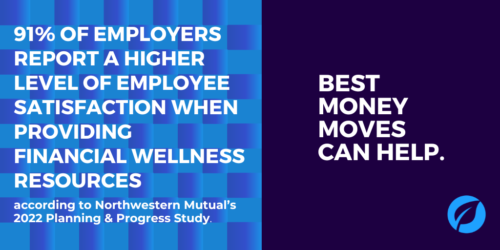
Ninety-seven percent of employers feel responsible for employee financial wellness, according to a 2022 study conducted by Bank of America. And 91% of employers report a higher level of employee satisfaction when providing financial wellness resources to their teams. It’s no surprise that more workforces are adding financial wellness benefits in 2023.

What’s more, research shows that financial stress is debilitating to productivity. A company of just 50 employees will face a productivity loss of upwards of $87,000 due to individual employees’ financial stress and those numbers only increase along with the size of your organization. Employers looking for ways to ease the burden of financial stress, while improving overall productivity and well-being should consider adding a financial wellness offering to their 2023 employee benefits package.  

2. Mental health support

The Money and Mental Health Policy Institute depicts the relationship between financial and mental wellness as a cycle: Financial strain can cause stress, anxiety, depression and other mental health challenges. This lack of motivation can in turn make it harder to earn and manage money, resulting in more financial stress. The cycle of financial stress and depression is found to have long-term, lingering effects on employee well-being.

Luckily, employers are poised to help by expanding mental health coverage in 2023. According to benefits expert SHRM, nearly 83% of wellness plan providers plan to assist with finding employee mental health care in addition to other wellness support. These resources, in addition to strong financial wellness efforts, can greatly alleviate employee pain points.

4. Increased work-from-home options

Many companies are also exploring permanent work-from-home options. According to Fortune, 78% of employers will offer the option to work from home regularly in 2023, and 66% will offer a four-day workweek or will work with employees to craft a flexible schedule. 

Remote or hybrid work can have strong benefits for employees. McKinsey’s American Opportunity Survey worked with market research leader Ipsos to survey 25,000 Americans on whether or not they would benefit from the option to work from home, returning 58 percent. With the cost of gas on the rise, allowing employees to work from home will relieve them of any transportation expenses. Additionally, just having the option to stay home means more personal time with no headache of a long commute. And for parents, it can mean being available to fit vital childcare around work duties.

Give your 2023 Employee Benefits a boost with a financial wellness solution from Best Money Moves.

Best Money Moves is a mobile-first financial wellness solution designed to help employees dial down their financial stress and meet their most top-of-mind financial goals. With budgeting tools and personalized money coaching, users can easily receive compressive financial advice right from their phones. 

Best Money Moves is designed to guide employees through the most difficult financial times and topics. Our dedicated resources, partner offerings and 700+ article library make Best Money Moves a leading benefit in bettering employee financial wellness.

To learn more about Best Money Moves Financial Wellness Platform, let’s schedule a call. Contact us and we’ll reach out to you soon.

Financial Wellness Leads to Employee Retention, Says Bank of America Report

Financial Wellness Leads to Employee Retention, Says Bank of America Report

Financial wellness leads to employee retention, says Bank of America report. Researchers find increasing evidence between financial wellness benefits and employee retention. Plus, 4 more highlights from the survey.

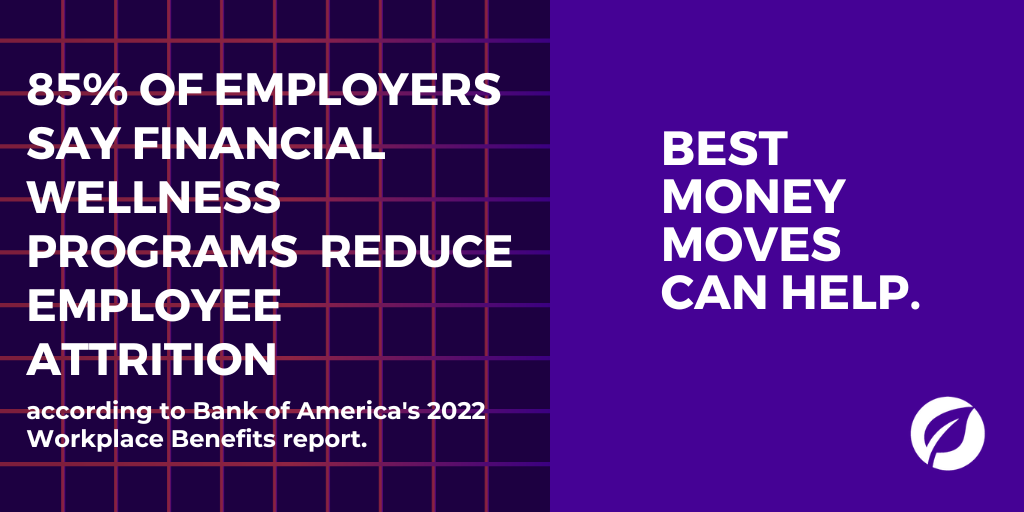
Employers are starting to realize the fuel value of financial wellness benefits. Compared to last year, more companies are offering financial wellness benefits and about 85% of employers say they reduce employee attrition, according to Bank of America’s 2022 Workplace Benefits report.

a helpful statistic about the connection between financial wellness programs and employee retention

Financial wellness resources are just one of many ways that companies can boost employee retention and attract top talent. Here are four retention-boosting ideas fit for any workforce:

1. Improve employee retention by investing in the health of your team.

Since the onset of the Covid-19 pandemic, companies have taken a more holistic approach to employee wellness. Instead of just focusing on physical health, companies have started offering benefits that support employees’ mental, financial and emotional health, too. In fact, 97% of employers feel somewhat responsible for their employee’s financial wellness, according to Bank of America’s survey. 

Exhibiting genuine care for employees’ wellbeing and wellness goes a long way, especially with attracting the best and brightest talent. Studies have shown that employees actively seek out companies that are invested in employee wellbeing, even if that means looking for a new job. 

2. Elevate DEI initiatives and programs.

Today, young employees are increasingly more diverse than older generations. In fact, only 17% of the Baby Boomer workforce is diverse, compared to 35% of the Gen Z and Millennial workforce. To capture top, diverse talent, companies have invested in diversity, equity and inclusion (DEI) efforts. When enacted efficiently, these DEI efforts can simultaneously bolster recruitment and talent management efforts.

About 3 in 4 employers believe that DEI programs are important for retaining talent, per the same Bank of America survey. Moreover, the diverse talent that flow through these corporate DEI programs are set to become the future leaders of tomorrow.

3. Help employees build future wealth to reduce employee retention.

Preparing for retirement doesn’t happen overnight, neither does accumulating wealth. Both processes require commitment and dedication over time, and more importantly, the resources to fund such efforts. Many Americans find it difficult to manage their current expenses and future savings, this likely explains why 1 in 4 Americans don’t have any retirement savings, according to a PwC survey. 

To help employees build future wealth, consider offering company match programs or financial advising to your workforce. Company match programs help employees multiply their retirement funds with the financial help of their employer. On the other hand, a financial advisor can help employees balance current and future money goals, with a personally tailored financial plan to follow. Both solutions are ways to help employees increase their financial security for the future.

4. Welcome upward feedback from all employees.

One way that companies continue to remain agile and grow is by incorporating upward feedback, a development evaluation for direct managers or upward leadership. 

Don’t wait until exit interviews to find out what’s working well and what needs tinkering, hold your firm accountable by actively commentary about the current ways of working. Leverage upward feedback as an opportunity to find out what makes people seek opportunities elsewhere and what makes them stay. 

Looking for a premium financial wellness solution to improve employee retention? Try Best Money Moves!

Best Money Moves is a mobile-first financial wellness solution designed to help dial down employees’ most top-of-mind financial stresses. As a comprehensive financial well-being solution, Best Money Moves offers 1:1 money coaching, budgeting tools and other resources to improve employee financial wellbeing. Our AI platform, with a human-centered design, is easy to use and fit for employees of any age. 

Whether it be college planning or securing a mortgage, Best Money Moves can guide employees through the most difficult financial times and topics. Our dedicated resources, partner offerings and 700+ article library make Best Money Moves a leading benefit in bettering employee financial wellness. 

To learn more about Best Money Moves Financial Wellness Platform, let’s schedule a call. Contact us and we’ll reach out to you soon.

3 Ways to Support Divorced Employees at Work

3 Ways to Support Divorced Employees at Work

3 Ways to support divorced employees at work. Divorce is a common but often overlooked strain on your workforce. Here are 3 ways to support the divorced employees on your team. 

The saying that, “half of all marriages end in divorce,” still holds true, according to data from the CDC. But despite the number of divorced employees in the workforce, employers are often unaware of how badly divorce can affect productivity and employee wellness.

According to data from Good Housekeeping, 67 percent of divorced people experience health and financial strain. Even more experience absenteeism and decreased productivity.

Consider these three ways to support divorced employees at work and relieve employee stress during times of difficult transition.

1. Provide flex time benefits to divorced employees who are navigating court dates or new childcare schedules.

Divorce also means facing the difficult emotions that come with an important relationship ending. According to the Holmes-Rahe Stress Scale, divorce is the second highest stressor a person can face, topped only by the death of a spouse. A Danish Frontiers in Psychology study found that men and women who had recently gone through a divorce displayed worse physical health, lower interest in social activities and  lower vitality than those who had not gone through a divorce. 

Offer a helping hand by investing in any of the wide array of behavioral health coaching programs available online. Nearly 88 percent of human resource professionals believe that mental health resources can boost employee productivity, according to data from CNBC. Data from SHRM also found that 35% of employees believe that mental health benefits are more important than salary or higher pay. 

You can also support your employees by lifting some of the financial weight and offering a financial wellness solution like Best Money Moves.

2. Offer a space to discuss mental health resources.

Many HR professionals have only created benefits packages while the economy was in full swing. Rocky roads ahead will force companies to transform quicker and be more open to change. Flexibility is a strength, but creating too many changes and losing sight of the long-term goals of a benefits program will lead to more issues. 

One area that employees are clamoring for more flexibility is in their work schedules. As travel costs skyrocket, providing employees remote work opportunities can help their wallets. According to LiveCareer, 3 out of 10 employees wouldn’t consider working at a company that didn’t offer remote work and 87% of working professionals felt connected with their organization despite working from home. Adapting to employee needs will keep employees afloat through difficult times without affecting productivity.

3. Offer financial wellness benefits to help divorced employees adjust to their new situation.

Divorcing employees are faced with significant new financial challenges, such as transitioning to a one-income household or navigating the new costs of childcare or alimony. 

They must also tackle the expenses associated with divorce itself. Forbes reports that the average divorce costs each spouse $7,000. Most divorces are agreed upon uncontested, which is more affordable than a contested divorce and doesn’t involve court dates. But a contested divorce can get expensive, as a lawyer will need to walk separating spouses through disagreements like child custody, visitation rights and spousal support. All parties involved have to spend a lot of time to reach agreements over these matters and usually, they aren’t resolved without going to court. 

Best Money Moves offers an extensive library of financial topics, which include how to handle financial stress. Our money coaches can walk your divorcing employee through budgeting and debt, and work with him or her to temper this new financial stressor. Your employee going through divorce can use the Best Money Moves budgeting tool to visualize their spending in categories, and receive overspending alerts. The budgeting tool gathers data on employees’ personal financial statuses to organize and attain healthy finances. 

Looking for financial wellness benefits to help your employees experiencing divorce? Start with Best Money Moves.

Best Money Moves is a mobile-first financial wellness solution designed to help dial down employees’ most top-of-mind financial stresses. With budgeting tools and personalized money coaching, users can easily receive comprehensive financial advice right from their phones.

Focused on user-friendliness, Best Money Moves is designed to bring financial wellness resources right to the fingertips of employees. Our dedicated resources, partner offerings and 700+ article library make Best Money Moves a leading benefit in improving employee financial wellbeing.

To learn more about Best Money Moves Financial Wellness Platform, let’s schedule a call. Contact us and we’ll reach out to you soon.

3 Ways to Recession-Proof Your Benefits Program

3 Ways to Recession-Proof Your Benefits Program

3 ways to recession-proof your benefits program.  How can your workforce prepare as a recession looms on the horizon? Here are 3 ways to recession-proof your benefits program. 

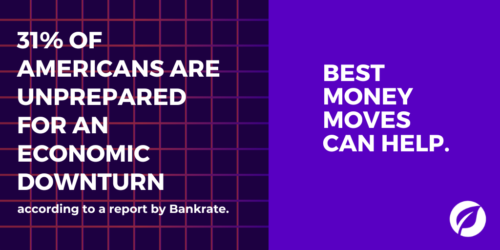
With a potential recession on the horizon, employers must focus on the financial wellbeing of their employees. Thirty-one percent of Americans are unprepared for an economic downturn, according to a report by Bankrate.

If companies hope to address the ever-changing needs of their employees they must create a benefits package that’s fit for economic hard-times. Here are 3 strategies to recession-proof your benefits program.

1. Before you recession-proof your strategy, know what your employees want most

A comprehensive benefits package can be the difference between landing a good and a great candidate. There are many aspects to a perfect benefits package, but it comes down to what the employees value the most. Sending out an employee survey is beneficial in finding how to best allocate your benefits budget. Also, in a tumultuous economic period, employees are looking for substance over flash.

Employees ranked work scheduling flexibility, healthcare and financial wellness programs as the benefits most important to them according to PeopleKeep. Focusing on the benefits that people want the most will also help employers save money on benefits with low utilization rates.

2. Have a concrete benefits philosophy, but be flexible

Many HR professionals have only created benefits packages while the economy was in full swing. Rocky roads ahead will force companies to transform quicker and be more open to change. Flexibility is a strength, but creating too many changes and losing sight of the long-term goals of a benefits program will lead to more issues. 

One area that employees are clamoring for more flexibility is in their work schedules. As travel costs skyrocket, providing employees remote work opportunities can help their wallets. According to LiveCareer, 3 out of 10 employees wouldn’t consider working at a company that didn’t offer remote work and 87% of working professionals felt connected with their organization despite working from home. Adapting to employee needs will keep employees afloat through difficult times without affecting productivity.

3. Make your plan recession-proof with a focus on financial wellness

One of the biggest changes caused by the recession is how employees treat their financial wellness. Workers will be more focused on their personal finances and it will take a toll on their mental health. 

Providing a comprehensive financial wellness benefit package is a perfect way for employers to tackle this issue head-on. A comprehensive package is beneficial to employees and employers alike. According to PWC’s financial employee wellness survey, 76% of financially stressed employees said their worries affected their productivity. The best financial wellness programs will undertake a holistic approach, tackling all arenas of personal finance from budgeting to investing. 

Take the first step toward a recession-proof benefits strategy with Best Money Moves. 

Best Money Moves is a mobile-first financial wellness solution designed to help dial down employees’ most top-of-mind financial stresses. As a comprehensive financial well-being solution, Best Money Moves offers 1:1 money coaching, budgeting tools and other resources to improve employee financial wellbeing. Our AI platform, with a human-centered design, is easy to use and fit for employees of any age, right from their mobile phones.

Whether it be college planning or securing a mortgage, Best Money Moves can guide employees through the most difficult financial times and topics. Our dedicated resources, partner offerings and 700+ article library make Best Money Moves a leading benefit in bettering employee financial wellness. 

To learn more about Best Money Moves Financial Wellness Platform, let’s schedule a call. Contact us and we’ll reach out to you soon.

4 Ways to Help All Employees Prepare for Retirement

4 Ways to Help All Employees Prepare for Retirement

4 ways to help all employees prepare for retirement. Data suggests that most U.S. households are behind on retirement savings. Here’s how companies can help their employees prepare for retirement. 

As a large number of Americans approach retirement age, many worry about rising costs. Employers are worried, too — 75% of employers fear that employees don’t have enough retirement savings, according to a TIAA survey and another 64% worry that employees may outlive their savings.

Learn how companies can help all employees — from new hires to those about to retire — prepare for retirement and financial stability in future.

About 8 in 10 pre-retirees cannot afford to retire

Most pre-retirees, or people 50-64 years old, do not have enough savings for retirement. In fact, according to a McKinsey study, over 80% of U.S. pre-retiree households are financially unprepared for retirement.

However, the actual percentage may be higher. This is because 1/3 of people have a false sense of confidence around their retirement preparedness, per the same McKinsey study.

Unforeseen and external factors can keep people from reaching their retirement goals, or even stop them from making retirement a priority. Here are three common challenges pre-retirees face, as they consider retirement:

  • Inflation is on the rise.
    Overtime, inflation can erode the purchasing power of the dollar — meaning the same dollar today won’t buy as many goods in the future. In turn, this can make retirement more expensive, as the dollar becomes devalued. It also means that people will have to save more now to account for future losses during retirement.
  • Focusing on other financial goals.
    Some people are focused on paying off student loan or credit card debt, as opposed to saving for retirement. Others may be looking to buy a home or just simply make ends meet — for this month. Regardless of one’s situation, not everyone’s focus is on retirement and not everyone prioritizes financial goals in the same way.
  • Unable to afford long-term care.
    The older people get, the more assistance they may need with daily activities and care. According to a Health Affairs research article, by 2029, 60% of seniors will have limited mobility and 20% will have a high need for health care and functional assistance. However, more than half won’t be able to afford the care they need.

4 ways to help all employees prepare for retirement:

Here are 4 ways companies can help their entire workforce prepare for retirement:

1. Offer a holistic financial wellness program.

Preparing for retirement requires more than just saving, it requires intentional planning and sometimes advising. However, not everyone can afford access to these resources. 

Consider investing in a holistic financial wellness program, which helps employees reach both short-term and long-term financial goals. Regardless of an employee’s situation or income level, a quality financial wellness program will provide personalized advice, for the near-term and long-term.

2. Consider auto-enrollment to encourage all employees to prepare for retirement

Auto enrollment is a company program that automatically enrolls all employees in a 401(k) or another retirement plan. The goal of auto enrollment is to increase employee participation in retirement benefits, but it also helps employees save earlier, and longer over time. A Principal survey found that 84% of employees say the key reason why they started saving for retirement so early is because they were auto enrolled by their firm.

3. Help employees prepare for retirement by educating them on their retirement benefits

Moving can be costly, especially when moving out of state for a new job. For instance, in the Chicago, Ill. metro area, the median asking rent is $2454 per month, according to Redfin data, and $4000 in the Boston and New York metro areas.  

To help reduce the financial burden of moving and housing, some leading companies have invested in relocation support for employees (e.g., company-sponsored moving services, subsidies or even temporary corporate housing). By offering relocation benefits, companies can support housing security for all employees, while themselves apart from the competition.

4. Start a company match program

A popular incentive companies use to get employees to save for retirement is by starting a company match program. When an employee contributes to their retirement fund, under a company match program, their employer will contribute the same amount, or in other words, “match” the contribution. This can help employees reach their financial long-term goals, with the financial support of their firm.

Need a financial wellness solution for your team? Try Best Money Moves!

Best Money Moves is a mobile-first financial wellness solution designed to help employees meet their most top-of-mind financial goals. With budgeting tools and personalized money coaching, users can easily receive comprehensive financial advice right from their phones.

Focused on user-friendliness, Best Money Moves is designed to bring financial wellness resources right to the fingertips of employees. Our dedicated resources, partner offerings and 700+ article library make Best Money Moves a leading benefit in improving employee financial wellbeing.

To learn more about Best Money Moves Financial Wellness Platform, let’s schedule a call. Contact us and we’ll reach out to you soon.