Best Money Moves Sneak Peek: Are Your Employees Financially Stable?

Best Money Moves Sneak Peek: Are Your Employees Financially Stable?

Best Money Moves Sneak Peek: Are your employees financially stable? Get a special inside look into the resource library of Best Money Moves.

Whether your employees need help with day-to-day budgeting, debt management, planning for their financial future or something in-between, our resource library can help. Best Money Moves users have access to over 900 unique articles, videos, webinars and calculators across a range of financial topics. Users at any point of their financial journey can find the guidance they need when they need it most.

Enjoy a sneak peek of a user-favorite Best Money Moves article: 10 questions to determine if you’re financially stable

Lots of moving pieces factor into your financial stability. Whether you’re trying to save, building a budget, planning for retirement or otherwise handling your money, it’s easy to get overwhelmed. However, there are questions you can ask to make sure you’re on the path toward financial stability — and steps to take if you’re not quite there yet.

1. Do you keep a budget?

Setting a fixed budget is the first step toward responsible spending. List your income and your expenses so you clearly see where to cut costs and save each month. 

Start by listing the total income you bring in each month, including your salary, a spouse or partner’s salary and other recurring income such as alimony or childcare. Then, compare this income to an itemized list of your expenses. It’s helpful to split your list into “fixed” expenses that stay constant every month (rent, car payments, etc.), and varied costs (entertainment, clothes). By splitting necessary costs from everything else, and keeping track of what you spend money on, you can better learn your spending habits and find places to reduce unnecessary spending.

2. Do you think through big purchases?

Patience is important when it comes to spending. While it’s easy to buy on impulse, splurging can result in purchases outside of your budget. When making a big purchase — whether a large appliance, a vacation or even a home — compare your options to find the best value.

3. Do you put money into savings every pay period? 

Saving is key to long-term financial stability. Building a savings ensures you’ll be prepared for whatever emergencies life throws your way. Even if you only put away a small amount each month, these savings will grow over time. 

To guarantee you save, try having your bank automatically transfer part of each paycheck to a savings account. If your bank isn’t able to do so, check with your employer to see if they can automatically deposit some of your paycheck into a savings account instead.

4. Do you have enough savings to cover three months of expenses?

According to the Federal Financial Literacy and Education Commission, you should have enough savings to cover three months of expenses before you start making any other investments. Our recommendation is to save closer to six months’ worth of expenses, but three months is a great place to start building your savings over time.

Regardless of your overall goal, if you have enough in savings to last you at least a few months, it likely means you’re in a healthy place financially and don’t have to stress about breaking your budget when an unexpected expense arrives. For more in-depth information on building an emergency fund, read our article How do I build an emergency fund?

5. Do you know what your credit score is and how to keep it in good shape?

Your credit score reflects your history of borrowing and paying back money and is comprised of a variety of factors, including your current unpaid debt, your history of paying bills and your total number of credit accounts. Banks and other lenders use your credit score to determine the likelihood that you’ll repay a loan on time. A high credit score means you’ll likely have an easier time qualifying for a mortgage, credit card or other forms of credit.

Many credit card companies or banking apps offer their customers a free monthly credit score, usually found on your monthly statement or by logging into your bank account’s mobile application. It’s important to note, however, that these free scores are generally educational scores and may be several points off from your actual score. Alternatively, you can purchase a copy of your credit score from each of the three nationwide credit bureaus Equifax, Experian and Transunion. 

Keep your score in good shape by paying your loans on time, not getting close to your credit limit and only applying for the credit you need and know you can pay back.

6. Do you have an established credit history?

Having an established history of using credit will help you with your credit score. The more often you pay your loans on time, the better your score will be and the better your chances are at receiving loans in the future. 

If you do not have experience with credit yet, the Consumer Financial Protection Bureau recommends looking into products designed to help you build credit. There are several options — such as secured credit cards and credit builder loans — that were created to kickstart your credit history.

7. Do you have alerts set up for your checking accounts?

Setting up alerts for your checking accounts is an easy way to avoid overdraft fees. Overdraft fees occur when you don’t have enough money in your account to complete a purchase, but the bank allows the transaction to go through anyway. Alerts on your account will tell you when you are low on money. This is important because, even if you’ve recently made a deposit, your funds may not be immediately accessible, which means that you can still overdraw your account and end up paying fees. 

Be proactive and set alerts to ensure you’re always aware of how much money you have access to at a given time.

8. Do you plan for your tax refund?

Financial stability is often contingent on financial planning, and having a plan for your tax refund can help you reach or maintain financial stability. 

Estimate how big your refund will be based on how much you earn, and then create a plan for its best possible use. Whether you put it into savings or use it to catch up on bills, planning ahead will help you make the most of your refund. 

To really plan ahead, put down your savings account and routing numbers when you file your taxes. This way, the IRS can deposit your check directly into savings so there’s no temptation to spend it right away.

9. Do you have long-term financial goals?

It’s always healthy to have long-term financial goals. Having realistic, specific goals can help you stay on track with your spending.  This concrete planning for the future motivates you to save and gets you to where you want to be financially.

10. Are you planning for retirement?

It’s never too early to start planning for the future, especially if you’ve reached a point where you can save money every month. A retirement fund may seem daunting or too far off to worry about, but contributing to one regularly can help you save up over time. 

The amount needed for a comfortable retirement varies from person to person, but a general rule is that you will need 70% of your current annual salary. However, if you plan on being very active in retirement, this number may be higher. 

If you haven’t started thinking about retirement yet, start by establishing an Individual Retirement Account (IRA) through your bank or other financial institution. An IRA is an account that allows you to save money for retirement with tax-free (or tax-deferred) growth. By keeping retirement in the back of your mind, you’ll ensure your financial stability lasts long after you stop working. 

Managing your finances may seem difficult at first, but there are many simple steps you can take to help you become more financially stable.

Best Money Moves gives your employees access to a detailed library of 900+ financial articles, videos, webinars and other tools.

Best Money Moves is a mobile-first financial wellness solution designed to help dial down employees’ most top-of-mind financial stresses. As a comprehensive financial well-being solution, Best Money Moves offers 1:1 money coaching, budgeting tools and other resources to improve employee financial well-being. Our AI platform, with a human-centered design, is easy to use and fit for employees of any age. 

Whether it be retirement planning or securing a mortgage, Best Money Moves can guide employees through the most difficult financial times and topics. Our dedicated resources, partner offerings and 700+ article library make Best Money Moves a leading benefit in bettering employee financial wellness. 

To learn more about Best Money Moves Financial Wellness Platform, let’s schedule a call. Contact us and we’ll reach out to you soon.

3 Ways Companies Can Fight Racial Wealth Inequality

3 Ways Companies Can Fight Racial Wealth Inequality

3 ways companies can fight racial wealth inequality. Learn more about the effects of wealth inequality and how organizations nationwide are working to promote racial wealth equity.

Racial wealth inequality is a pervasive problem for American workforces. The median household income is around $101,418 for Asian households and $77,999 for White households, according to data from the U.S. Census Bureau. However, the median for Hispanic households is $57,981 and the median for Black households is $48,297. 

Combating racial wealth inequality in the workplace requires time, resources and the participation of senior leadership. These three strategies target common sources of racial wealth inequality in order tp create a more equitable landscape for all employees.

A surprising stat related to the fight against racial wealth inequality

1. Target housing inequality with mortgage resources and advising.

For many, homeownership is a guaranteed track toward building wealth — however, this pathway to wealth isn’t paved the same for all Americans. Today, the mortgage lending process continues to be entrenched with racial bias and discrimination — Black mortgage applicants are 80% more likely to be denied, compared to their White counterparts, according to the Center for Public Integrity. And if approved, Black homeowners are usually given costlier, higher-risk mortgages than their White counterparts — ultimately, leading to less wealth amassed over time. 

Policymakers and the private sector have an opportunity to help create a more equitable path toward homeownership and obtaining a mortgage. For instance, some corporations have invested in employee financial benefits that support future homeowners, such as access to small-balance mortgage loans or down payment assistance programs. Other companies offer 1:1 financial advising, which can help employees compare mortgages. Together, these resources can help employees root out racial disparities in the homeownership process, like disproportionately worse mortgage loans.

2. Fight racial wealth inequality with student loan assistance.

Even years after graduation, many employees still battle looming student loan debt. However, Black and Brown employees tend to carry about 30% more student loan debt than their White counterparts, according to research by the U.S. Treasury Department. This is a result of compounded inequality; the lack of wealth for Black and Brown families doesn’t allow them to pay for college, which in turn forces many Black and Brown students to accumulate thousands in debt to pay for school.

Student debt follows many people into the full-time workforce; however, for Black and brown employees, it’s disproportionately more difficult to pay off student loans. For every dollar that Black families earn, White families earn $6, according to the Federal Reserve Bank of Minneapolis. Black and Brown families have less money to allocate for bills and other expenses, including student debt. 

To help employees combat their student loan balance, companies have been investing in student loan repayment benefits. For instance, some firms offer a match assistance program, where as long as employees make contributions to their student loan balances, their employer will also contribute a certain percentage toward repayment. This assistance can accelerate employees’ path toward becoming debt-free and increasing their overall wealth.

3. Contribute to employees’ emergency funds.

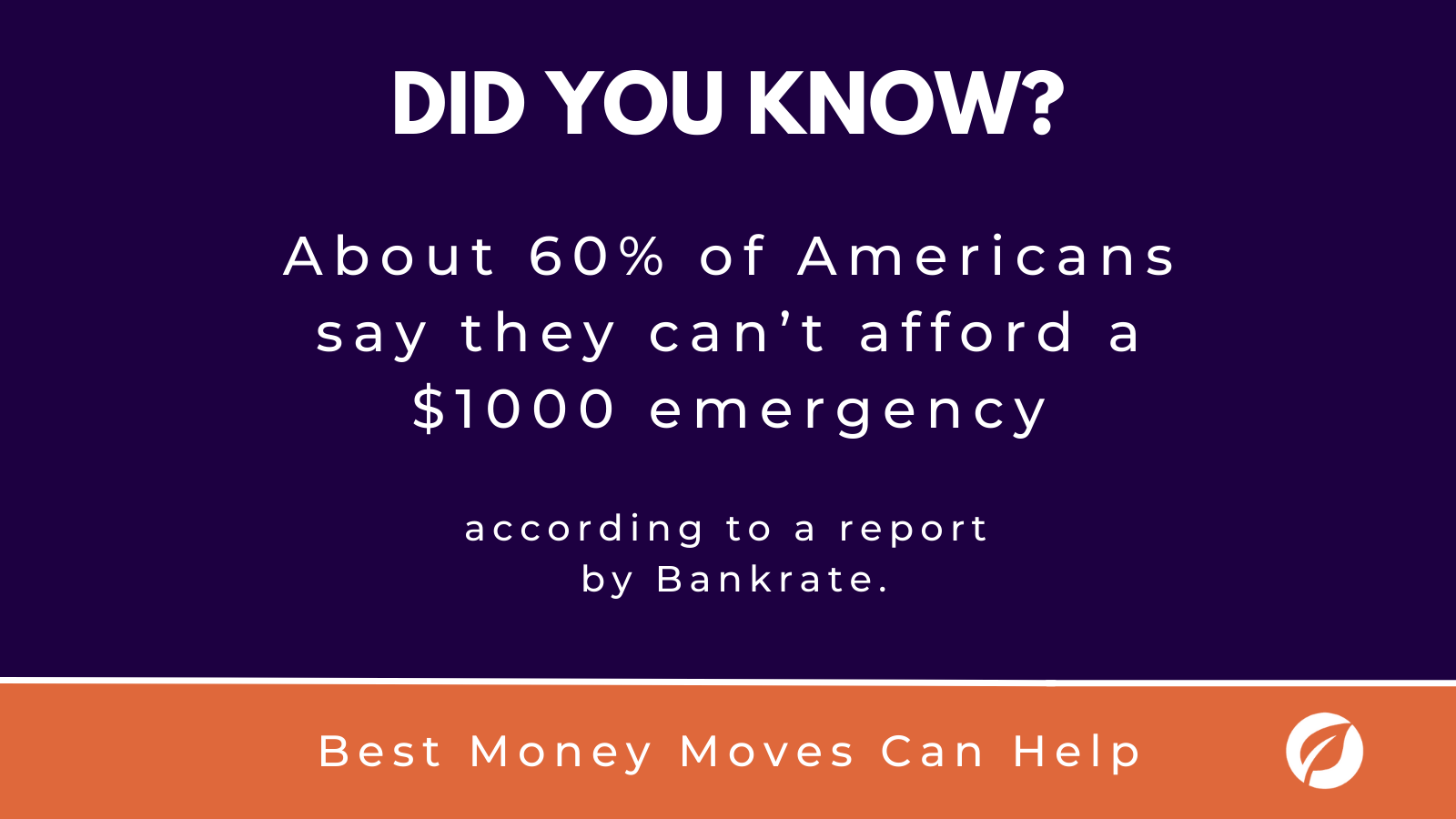
A key element of financial wellness is the ability to cover emergency expenses. About 60% of Americans say they won’t be able to afford a $1,000 emergency, according to a 2023 Bankrate report, without going into debt. This inability to afford a $ 1,000 emergency is a huge indicator of poor financial wellness, moreover, it can leave Americans at risk for more debt. 

Although debt affects all Americans, it affects Black and brown Americans differently. According to the Aspen Institute Financial Security Program (FSP), Black and brown employees are more likely to face negative consequences for their looming debt, such as bankruptcy, debt collection lawsuits and poor mental health.

Sometimes creditors or debt collectors will resort to lawsuits in an attempt to collect owed money — generally about 15% of debts are sued by a creditor or debt collector regarding unpaid funds. However, according to the Aspen Institute FSP, the majority of the debtors sued for unpaid funds identified as either Black or Latinx. 

Companies across the nation have presented several solutions that can aid employees during financial emergencies. For instance, some have increased employees’ access to affordable loans and lines of credit by investing in financial wellness solutions. Other companies have invested in emergency funds (also known as rainy day funds) for employees — these funds are designed to help employees save for, and afford, a financial emergency, without having to go into debt or dip into their 401(k) savings.

Looking for a financial wellness program fit for all? Consider Best Money Moves.

Best Money Moves is a mobile-first financial wellness solution designed to help dial down employees’ most top-of-mind financial stresses. As an easy-to-use financial well-being solution, Best Money Moves offers comprehensive support toward any money-related goal. With 1:1 money coaching, budgeting tools and other resources, our AI platform is designed to help bolster employee financial wellbeing. 

Whether it be paying off debt or securing a mortgage, Best Money Moves can guide employees through the most complex financial times and topics. We have robust benefits options for employers, regardless of their benefits budget. 

Our dedicated resources, partner offerings and 700+ article library make Best Money Moves a leading benefit in bettering employee financial wellness.

To learn more about Best Money Moves Financial Wellness Platform, let’s schedule a call. Contact us and we’ll reach out to you soon.

Employee Financial Resilience: Help Your Team Weather Any Crisis

Employee Financial Resilience: Help Your Team Weather Any Crisis

Employee financial resilience: Help your team weather any crisis. After years of economic turmoil, employee financial resilience has never been more important. Here’s how to foster financial resilience among your team. 

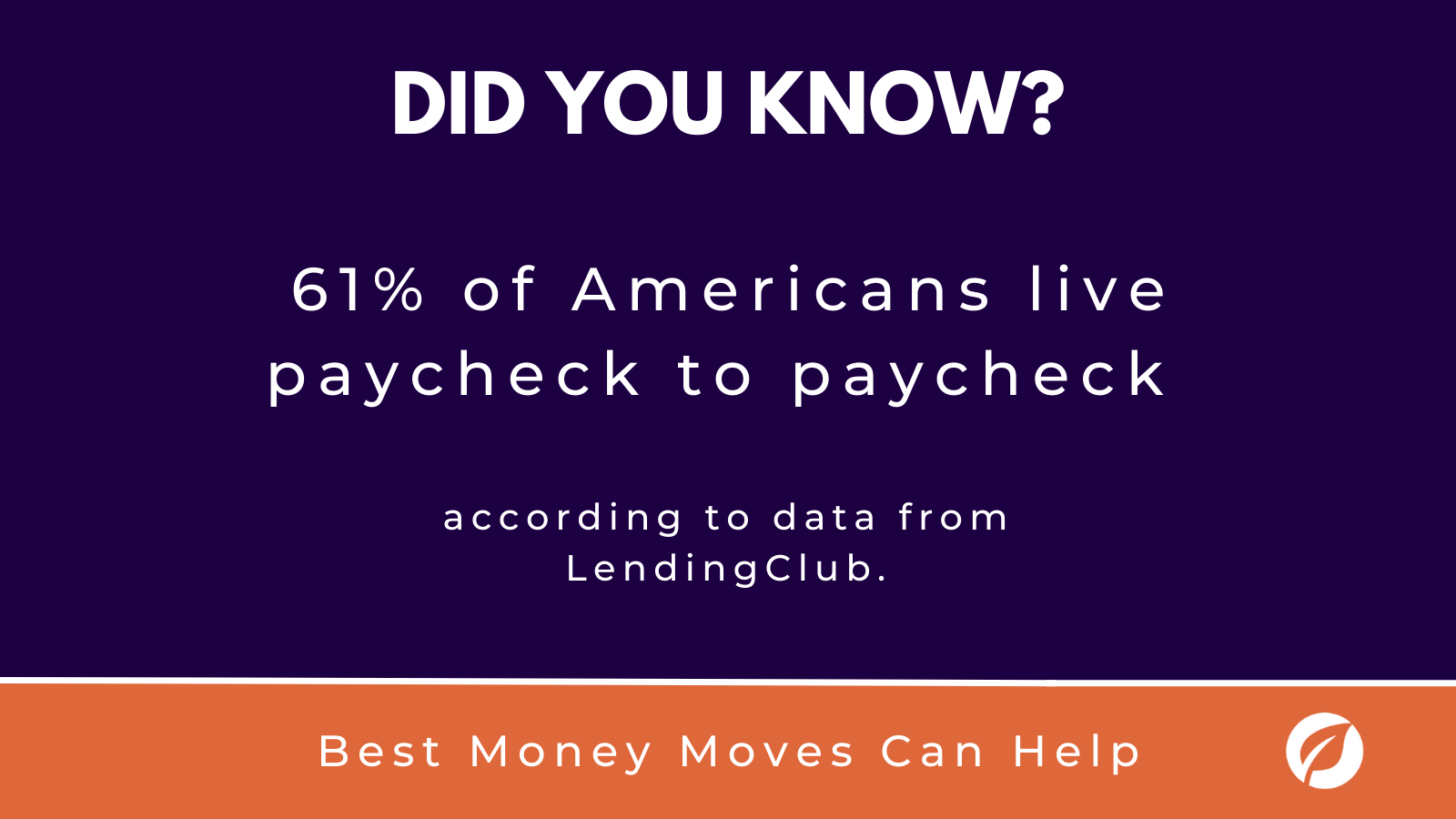
Employees have faced several years of significant economic turmoil. From a global pandemic to prolonged inflation and the looming threat of a recession, the budgets and spending habits of many have been strained. Today, 61% of Americans live paycheck to paycheck, according to data from LendingClub, a 9.3 million person increase from 2021. 

Employee financial resilience has never been more important. Here’s how employers can foster resilience in their employees to help their workforce whether any storm.

a key fact about the need for employee financial resilience

What is employee financial resilience? (And what does it matter to your team?)

Financial resilience is the ability to withstand major unexpected life events without leaving a major impact on personal finances. This is an ability that can be honed for minimum-wage and high-salaried employees alike. According to PWC’s 2023 employee financial wellness survey, even amongst employees making over $100,000 a year, 47% are stressed about their finances. The impact of financial stress can have a significant negative impact on the mental health of your employees as well. As an employer, it’s mandatory to understand financial resilience and to provide financial wellness tools that will help your employees through difficult periods. 

Employee financial strain has many negative side effects ranging from a decrease in productivity to negatively influencing company culture. An additional benefit to a financially resilient workforce is a reduced turnover rate. According to the 2022 PWC Employee Financial Wellness Survey, employees who are undergoing financial stress are twice as likely to seek new employment. Employers who take the initiative in curbing their employee’s personal finance woes will see increased returns in both the personal and the business sides of their organizations.

Building a financially resilient workforce

Building a financially resilient workforce takes a concerted effort from employers to assist and connect with their employees. One of the easiest ways to do so is by changing the culture of your workplace especially when it comes to discussions about money. Talking about personal finance is a sensitive subject, but that unwillingness to open up can push employees further down a spiral of poor habits. Changing the culture around finances will not only help identify when an employee is in trouble but can also assist in increasing participation in programs that companies provide to their employees.

These recent periods of instability have also highlighted the importance of providing comprehensive financial wellness programs. Many companies include some form of personal finance assistance in their employee benefits program, but it doesn’t cover all of their worker’s needs. When problems arrive, it’s important that employees have some base of financial education to improvise and adapt to their ever-changing situations. Each employee has their own set of diverse and challenging personal finance problems, so having a solution that can apply to everyone is imperative.

Bolster employee financial resilience with key financial wellness tools from Best Money Moves.

Best Money Moves is a mobile-first financial wellness solution designed to help dial down employees’ most top-of-mind financial stress. As an easy-to-use financial well-being solution, Best Money Moves offers comprehensive support toward any money-related goal. With 1:1 money coaching, budgeting tools and other resources, our AI platform is designed to help improve employee financial wellbeing. Our intuitive, easy-to-use program platform is fit for employees of any age and level of financial literacy.

Whether it be retirement planning or securing a mortgage, Best Money Moves can guide employees through the most difficult financial times and topics. We have robust benefits options for employers, regardless of their benefits budget. 

Our dedicated resources, partner offerings and 900+ article library make Best Money Moves a leading benefit in bettering employee financial wellness.

To learn more about Best Money Moves Financial Wellness Platform, let’s schedule a call. Contact us and we’ll reach out to you soon.
3 Ways to Maximize Your Financial Wellness Benefits

3 Ways to Maximize Your Financial Wellness Benefits

3 ways to maximize your financial wellness benefits. Financial wellness is a must-have employee benefit — learn how to maximize your financial wellness program.

Today, almost 35% of companies have financial wellness offerings for their employees, up from 25% in 2020, according to the Employee Benefit Research Institute (EBRI). Financial wellness benefits help companies help reduce attrition, attract top talent and improve the overall wellbeing of their employees.

Whether your team already offers financial wellness tools or is looking to build a new plan these three strategies can help maximize your benefits.

a surprising fact about the importance of employee financial wellness benefits

1. Supplement online tools with live, 1:1 financial guidance.

Every employee’s financial situation is unique — with a financial advisor, employees can talk through any issues they’re facing and receive personally tailored support. For some employees, live money coaching is an easier, less intimidating avenue to receive financial support than engaging with self-guided online tools. Working with an advisor can offer a more accessible avenue for receiving financial advice.  

It’s also a good idea to contract financial advisors outside of your employees’ retirement plan. Of the employers that offer financial advising, 65% of them offer this benefit through their retirement representative, according to EBRI’s report. 

While retirement providers are often a source for financial advice, they are not the preferred source for financial advice among employees. According to PWC’s 2023 report, employees of all ages say they’d prefer and trust an objective financial advisor not tied to financial products or their company retirement plan. Look for advisors who can provide objective, personalized guidance across a range of financial topics.

2. Shift toward a holistic financial wellness benefits.

Employees across different demographics suffer from different pain points. Instead of simply offering one aspect of financial wellness, like a retirement plan or student loan support, a holistic program packages multiple offerings together. Tools such as budgeting aids and loan calculators can help boost employees’ overall financial wellness and are helpful across a wide spectrum of financial situations. 

For companies unsure of where to begin with building a holistic financial wellness program, start by bundling together financial wellness benefits that are beneficial for your specific workforce. Consider: What are the main financial issues, stressors, or insecurities that your employees face? What tools and/or resources can help employees face these issues head-on?

Even if you already offer a holistic financial wellness program, companies are continuously innovating their financial wellness offerings, so it’s important to look for a program that provides new materials and tools over time. In fact, 79% of the companies currently offering financial wellness initiatives said they were encompassing more benefits, according to EBRI’s report.

3. Provide savings tools to help employees build funds for a rainy day.

While there are many forms of emergency fund or employee hardship benefits, many of the existing options rely on already-available money sources — the most common emergency fund benefit offered is withdrawals from after-tax retirement, followed by employee relief/compassion funds. The least commonly offered emergency fund benefit is rainy day funds.

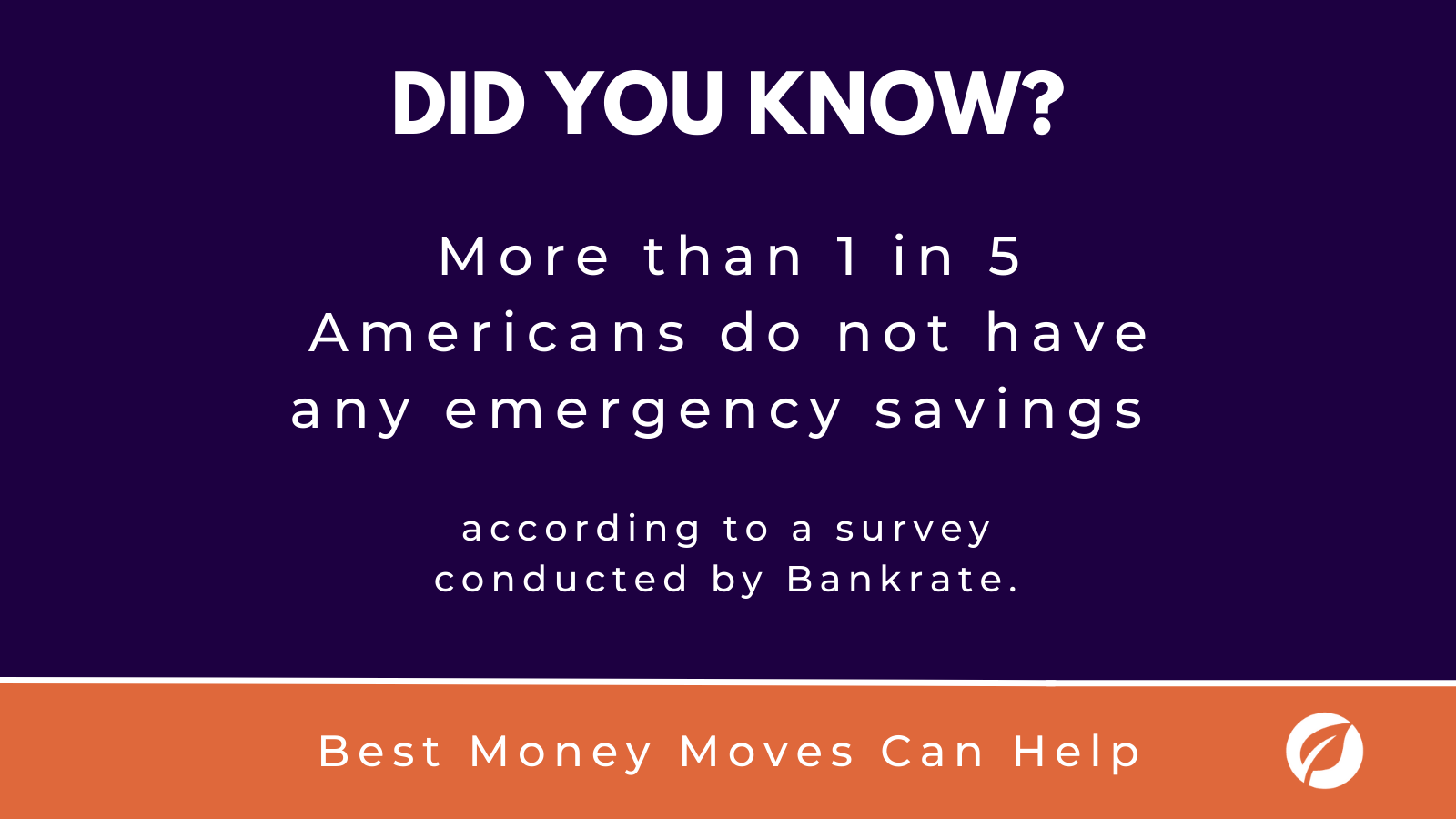
However, rainy day funds allow employees to prepare for short-term emergencies without obstructing their monthly budget and finances. Today, more than 1 in 5 Americans do not have any emergency savings and cannot afford a $1000 emergency, according to a Bankrate 2023 survey. By helping employees build designated emergency savings, employers can help employees boost their financial wellness, and avoid going into debt or dipping into their retirement accounts.

Maximize your financial wellness benefits with Best Money Moves.

Best Money Moves is a mobile-first financial wellness solution designed to help dial down employees’ most top-of-mind financial stresses. As an easy-to-use financial well-being solution, Best Money Moves offers comprehensive support toward any money-related goal. With 1:1 money coaching, budgeting tools and other resources, our AI platform is designed to help improve employee financial well-being. 

Whether it be retirement planning or securing a mortgage, Best Money Moves can guide employees through the most difficult financial times and topics. We have robust benefits options for employers, regardless of their benefits budget. 

Our dedicated resources, partner offerings and 700+ article library make Best Money Moves a leading benefit in bettering employee financial wellness. 

To learn more about Best Money Moves Financial Wellness Platform, let’s schedule a call. Contact us and we’ll reach out to you soon.

5 Surprising Facts About Employee Financial Wellness

5 Surprising Facts About Employee Financial Wellness

5 surprising statistics about employee financial wellness. Employee financial wellness has a big impact on employee wellbeing and productivity. Here are a few key statistics to know. 

Stress over personal finances continues to impact workers both in the home and at the office. Your workforce is suffering as a result.

In January 2023, PWC surveyed 4,000 employed U.S. adults about their personal finances and financial stress. The resulting answers reveal several alarming facts about how financial stress impacts overall employee well-being and performance.

Here are 5 of the most surprising facts from the survey — plus, what employers can do to help. 

surprising statistic about how employee financial wellness impacts productivity

5 Surprising Statistics About Employee Financial Wellness

1. Employees are losing sleep over their financial situation.

In the past year, 56% of employees said that their personal finances had a negative impact on their sleep. Another 55% of employees said that their finances had a negative impact on their mental health. The most startling aspect of this fact is that these numbers are higher than during the height of the pandemic. 

Stress has long been linked to physical ailments including insomnia, anxiety, restlessness and irritability — all of which may contribute to negative employee outcomes including lowered engagement and increased absenteeism. Targeting financial strain may actually help improve an employee’s overall wellness.

2. Financially stressed employees are more distracted at work and more likely to seek another job.

Among financially stressed workers, only 54% said that they felt a future at their current position compared to 69% amongst those who are not financially stressed. Additionally, financially stressed employees are twice as likely to be actively seeking a new position. Only around half of financially stressed employees report seeing a future with their current employer. 

One of the bigger causes of stress for employees is organizational change, showing that stability throughout an organization company can pay dividends down the line. One way to reduce employee turnover is to curate a company culture that fosters employee resilience, even through times of financial uncertainty. Look to provide tools that address employee stress head-on and talk to your employees openly about the importance of financial well-being.

3. Cost-of-living is outpacing employee earnings.

59% of employees say that their salaries are not keeping up with the cost of living expenses. What’s more, the financial tools provided by their employers aren’t enough to bridge the gap. Most financial wellness benefits are geared toward future goals, such as building savings or retirement. While these can be helpful for long-term planning, they miss the mark for employees who are struggling with day-to-day expenses.

Twenty-eight percent of full-time employees report running out of money between paychecks. In addition to long-term help, employees need financial wellness benefits that address day-to-day financial challenges. Look for wellness solutions that can provide budgeting and debt repayment options in addition to planning for future goals. The right solutions can help your team avoid living paycheck-to-paycheck.

4. Employee performance consistently suffers as a result of financial stress.

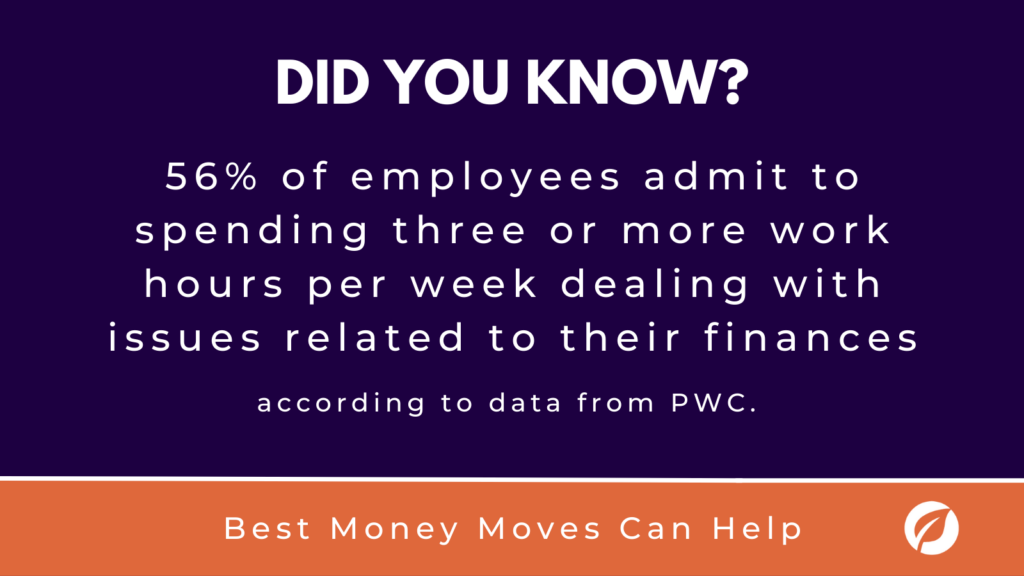
Financial stress is a major distraction — 56% of employees admit to spending three or more work hours per week dealing with issues related to their finances. Data suggests that these stressed employees are also less engaged with their work overall.

One of the best ways to combat distraction is to provide financial wellness solutions that are personalized for each employee. Look for tools that cover a wide range of financial wellness topics, whether or employees are looking for help budgeting, saving, paying down debt or something in-between. Selecting tools with in-depth personalized advice can cut down the amount of time employees spend looking for help while still on the clock.

5. Employees are increasingly looking towards their employers when searching for help with their personal finances.

Some good news among more worrisome data: 74% of employees seek financial assistance when facing financial decisions, crises or life events. 

Additionally, the stigma of asking for help with your finances has decreased. According to PWC data, 33% of employees said they would be embarrassed to ask for assistance compared to 42% in 2019. Push that number down even further by openly promoting your benefits offerings around the office, so that employees know help will be available when they’re ready to ask for it.

Best Money Moves could be the solution you need to support your employees.

Best Money Moves is a mobile-first financial wellness solution designed to help dial down employees’ most top-of-mind financial stresses. As a comprehensive financial well-being solution, Best Money Moves offers 1:1 money coaching, budgeting tools and other resources to improve employee financial well-being. Our AI platform, with a human-centered design, is easy to use and fit for employees of any age, right from their mobile phones.

Whether it be college planning or securing a mortgage, Best Money Moves can guide employees through the most difficult financial times and topics. Our dedicated resources, partner offerings and 700+ article library make Best Money Moves a leading benefit in bettering employee financial wellness.

To learn more about Best Money Moves Financial Wellness Platform, let’s schedule a call. Contact us and we’ll reach out to you soon.