4 Surprising Ways Financial Stress Impacts Your Team

4 Surprising Ways Financial Stress Impacts Your Team

4 surprising ways financial stress impacts your team. Whether you know it or not, your team is struggling with financial stress. Here’s what you could be missing. 

Financial stress is on the rise among American workers and, whether you know it or not, your team is feeling the effects. The Thriving Wallet Survey, conducted by Discover and Thrive Global highlights startling financial health statistics and dives into the connection between workplace performance and employee mental health. 

Here are 4 surprising insights from the survey highlighting the ways that financial stress could be affecting your team.
 

1. Money is the number one cause of stress in the United States.

As the world recovers from the effects of the COVID-19 era, many managers are trying to return to “business as usual” without keying in on the longer-lasting ramifications of the pandemic. While the cause of the problem does not fall solely on employers, many employees feel as if their organizations should be doing more to assist their personal finances. A Bank of America study found that 82% of employees say employers should play a role in supporting their financial wellness. Additionally, in the same study, 97% of employers feel responsible for their employees’ financial health. While many employers feel responsible, few are making enough action towards solving the issue.

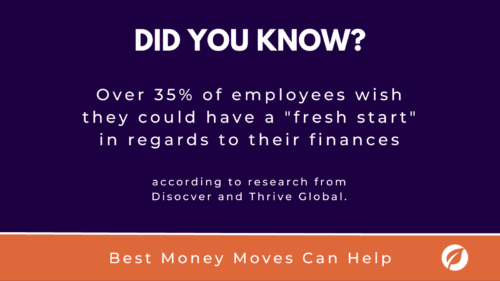
2. Over 35% of employees wish they could have a “fresh start” in regards to their finances.

While 35% of employees feel this, taking the steps necessary in order to retool their financial health can be difficult and embarrassing. Providing financial health benefits not only makes it easier for employees to access financial education, but helps destigmatize the idea of receiving personal finance assistance.  According to a recent survey conducted by Commonwealth and MetLife Foundation, 65% of workers said employers should be doing more to address financial insecurity. Part of “doing more” includes proactively taking measures to ensure the most people are comfortable participating in their benefits.

3. Ninety percent of individuals say that they are impacted by financial stress.

In a study by the Anxiety and Depression Association of America, 56% of employees reported that their anxiety and stress impacted their work performance. Stressed employees turn into distracted and unproductive employees. Providing financial wellness benefits is a mutually beneficial practice amongst employers and employees. Also, taking extra steps in order to ensure the mental health of employees can help businesses attract and retain staff.

4. Employers lose up to $250 billion dollars per year due to employees’ financial stress

With talks of a potential recession populating the front page of many major news sites, organizations should act now in order to help assuage concerns and ensure the health of their employees. Providing employees with financial health benefits not only increases the wellbeing of employees, it can also provide financial benefit to organizations. The most effective benefits strategy is to provide a comprehensive financial wellness platform that can be personalized to each employee’s unique needs.

By offering financial wellness programs, like Best Money Moves, employers can help employees manage their financial stress.

Best Money Moves is a mobile-first platform that offers personalized financial planning and coaching resources, focused on solving your employees’ pain point. The program uses artificial intelligence, along with a human-centered design, to measure employee financial stress and then dial it down with personalized solutions. Our triggers and alerts system — as well as budgeting tools, personal finance resources and more — help guide employees to make more informed financial decisions and reduce their overall stress.

To learn more about Best Money Moves Financial Wellness Platform, let’s schedule a call. Contact us and we’ll reach out to you soon.

3 Ways to Prepare Your Employees for a 2023 Recession

3 Ways to Prepare Your Employees for a 2023 Recession

3 ways to prepare your employees for a 2023 recession . Financial experts predict a possible 2023 recession. Here are 3 key strategies to consider to help employees through a recession.

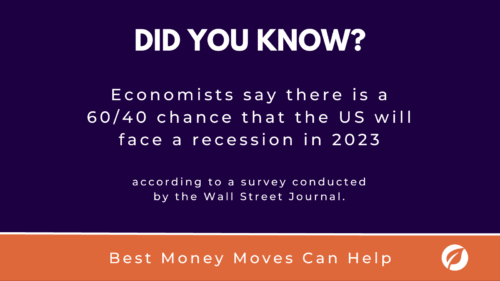
Economists say there is a 60/40 chance that the US will face a recession in 2023, according to a survey conducted by the Wall Street Journal. This news follows a year where significant inflation and climbing interest rates challenged employee financial confidence. 

Employers need to equip their staff with the right resources if they hope to remain productive amid a large scale financial downturn. Here are three ways to prepare your employees for a 2023 recession.

1. Address the challenges of a 2023 recession head-on with accessible financial wellness tools.

Financial wellness tools are always a good investment for you team, but they’re never more important than during periods of economic upheaval. Over 62% of employees are stressed about their finances, according to The Bank of America 12th Annual Workplace Benefits Report. What’s more, 80% of employees worry about inflation and 71% of those feel that their wages are not on track to keep up with the cost of living.

With a 2023 recession on the horizon, it’s time to address employee financial needs head-on. In the same Bank of America study, research found a significant link between employer involvement in financial wellness and employee attrition. A whopping ninety-seven percent of employers report feeling responsible for their employee’s financial wellness. What’s more, 84% of employers felt that offering financial wellness tools helped with retention. With this in mind, it’s hardly a surprise that financial wellness is shaping up to be one of the top benefits of 2023. 

2. Invest in benefits with a DEI edge.

Research suggests that workplaces who prioritize diversity, equity and inclusion efforts tend to fare better during times of upheaval. Data collected by AARP international and Great Place to Work, found that diverse organizations performed nearly four times better than their competitors who employed less diverse teams, during the 2008 recession. 

Financial wellness solutions are a key benefit when thinking about DEI. All employees, regardless of their backgrounds, have to deal with financial matters in some capacity. Moreover, minority employees often find themselves the most in need of financial wellness support. White families have an average eight times the wealth of black families, and five times the wealth of hispanic families, according to 2020 research from the federal reserve. Female employees are also disproportionately affected by financial stress compared to their male colleagues. Data from the Financial Health Network found that the pandemic only served to widen this gap. 

Addressing these disparities among your team starts with making sure everyone has access to the same financial tools, resources and education to address their individual needs. Financial solutions can can also be a great way to retain and attract new, diverse talent as 4 out of 5 employees said they would prefer benefits over a pay increase, per Human Resources Director.

3. Promote work-life balance and build trust in your team — wherever they work.

If employees are to face a 2023 recession, work-life support from employers will become more important than ever. A 2021 survey conducted by Ernst & Young Global recorded that 54% of respondents worldwide said they might leave their jobs without flexibility in the post-pandemic era. And the reason why often comes down to a matter of money. 

For many families, tough financial times means making hard decisions about inflexible expenses like health or childcare. Juggling personal responsibilities is a big part of employees’ budgeting: for some working parents, a recession could mean determining if they can afford to keep sending a child to daycare during the workweek. 

Knowing that their companies trust them to do their jobs well remotely can have a huge impact on employee retention and attracting new employees. When surveyed by Harris Poll, seventy-six percent of workers cited a desire for their employers to implement remote work some or all of the time. 

Be prepared for a 2023 recession with financial wellness tools from Best Money Moves.

Best Money Moves is a mobile-first financial wellness solution designed to help dial down employees’ most top-of-mind financial stresses. As a comprehensive financial well-being solution, Best Money Moves offers 1:1 money coaching, budgeting tools and other resources to improve employee financial wellbeing. Our AI platform, with a human-centered design, is easy to use and fit for employees of any age, right from their mobile phones.

Whether it be college planning or securing a mortgage, Best Money Moves can guide employees through the most difficult financial times and topics. Our dedicated resources, partner offerings and 700+ article library make Best Money Moves a leading benefit in bettering employee financial wellness.

To learn more about Best Money Moves Financial Wellness Platform, let’s schedule a call. Contact us and we’ll reach out to you soon.

Financial Stress in 2023: 3 Problems Facing Your Workforce

Financial Stress in 2023: 3 Problems Facing Your Workforce

Financial Stress in 2023: 3 Problems Facing Your Workforce. 2023 is shaping up to be a tough financial year. Keep an eye out for these 3 major causes of financial stress among your employees.

Average savings decreased by 15% in 2022, according to Northwestern Mutual’s 2022 Planning & Progress Study.  What’s more, data from the same study confirms that over half of U.S. adults feel somewhat or very anxious about their financial situation. 

With a recession looming in 2023, helping employees bolster their financial health should be at the top of every employer’s to-do list. Here are the top 3 financial issues facing your workforce in 2023.

1. Inflation remains the top cause of financial stress for many employees.

Inflation was one of the biggest news stories throughout 2022, so it’s no surprise that rising prices remain top of mind for many employees. According to CNN, global inflation rose from 4.7% in 2021 to 8.8% this year and is projected to be at 6.5% in 2023. This growth has forced families to tighten their budgets and make tough choices about competing expenses. In a survey of roughly 1,000 U.S. adults conducted by NPR/PBS news, 72% reported having to cut at least one major expense in the wake of rising inflation. 

Stress over inflation and other financial hurdles frequently follows employees into the office. Financial stress results in higher levels of absenteeism and lowered productivity. The American Institute of Stress reports that more than 275 million days of work are lost annually due to the stress of American workers.

2. Rising interest rates could slow your employees’ financial progress.

To help combat inflation, the Federal Reserve has steadily raised interest rates throughout the course of 2022. According to the Economist, the markets are expecting the Federal Reserve to raise interest rates as high as 5% in 2023. Increased interest rates may help curb inflation, but they also present a stumbling block for employees on the road to homeownership or debt repayment. This is especially true for households of color, according to data from housing research nonprofit, the Urban Institute. Many of these households are still recovering from the significant financial ramifications of the COVID-19 pandemic. 

It should be a major focus for employers to help workers assuage their fears around interest rates and provide assistance for their personal finances. Including these benefits not only increases the well-being of current staff, but also entices potential newcomers. According to Financial Wellness Magazine, 40% of employees say that financial planning and education benefits are important when deciding a new job. These programs are also increasing in importance for younger generations, so providing financial wellness programs can also set your company up for the future.

3. Slowing economic growth creates financial stress and uncertainty about the future.

Looking towards 2023, global economic prospects are the 3rd weakest since 2021, according to the International Monetary Fund. The effects of the slowdown have fully trickled down, affecting many Americans and their salaries.  

According to CNBC, 60% of Americans are currently living paycheck to paycheck. Many people who are used to living comfortably have been forced to drastically cut costs and change their spending behavior. It can be difficult to pin down what areas are hurting your personal finances the most. Utilizing a comprehensive financial wellness program is an effective tool to combat your employee’s personal finance woes.

Give your 2023 Employee Benefits a boost with a financial wellness solution from Best Money Moves.

Best Money Moves is a mobile-first financial wellness solution designed to help employees dial down their financial stress and meet their most top-of-mind financial goals. With budgeting tools and personalized money coaching, users can easily receive compressive financial advice right from their phones. 

Best Money Moves is designed to guide employees through difficult financial times and topics. Our dedicated resources, partner offerings and 700+ article library make Best Money Moves a leading benefit in bettering employee financial wellness.

To learn more about Best Money Moves Financial Wellness Platform, let’s schedule a call. Contact us and we’ll reach out to you soon.

4 Top 2023 Employee Benefits

4 Top 2023 Employee Benefits

4 top 2023 employee benefits. Here are the trending employee benefits that companies are investing in for 2023, to help cope with financially stressful times.

The International Monetary Fund estimates that 2023 will see global economic growth decline to only 2.7 percent in 2023. This is a significant drop from the 6.0 percent growth recorded in 2021, and the lowest since 2001. 

Employers should consider these numbers when planning their 2023 employee benefits: A recession is likely on the horizon. 

The top 2023 employee benefits 

Here are 4 top 2023 employee benefits to inspire your staff and keep them feeling secure in a financially uncertain year. 

1. Financial wellness benefits

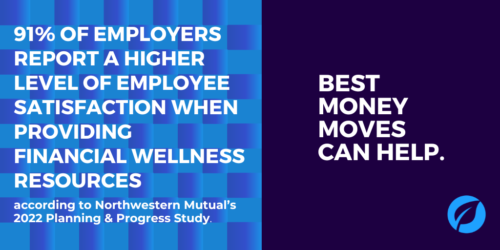
Ninety-seven percent of employers feel responsible for employee financial wellness, according to a 2022 study conducted by Bank of America. And 91% of employers report a higher level of employee satisfaction when providing financial wellness resources to their teams. It’s no surprise that more workforces are adding financial wellness benefits in 2023.

What’s more, research shows that financial stress is debilitating to productivity. A company of just 50 employees will face a productivity loss of upwards of $87,000 due to individual employees’ financial stress and those numbers only increase along with the size of your organization. Employers looking for ways to ease the burden of financial stress, while improving overall productivity and well-being should consider adding a financial wellness offering to their 2023 employee benefits package.  

2. Mental health support

The Money and Mental Health Policy Institute depicts the relationship between financial and mental wellness as a cycle: Financial strain can cause stress, anxiety, depression and other mental health challenges. This lack of motivation can in turn make it harder to earn and manage money, resulting in more financial stress. The cycle of financial stress and depression is found to have long-term, lingering effects on employee well-being.

Luckily, employers are poised to help by expanding mental health coverage in 2023. According to benefits expert SHRM, nearly 83% of wellness plan providers plan to assist with finding employee mental health care in addition to other wellness support. These resources, in addition to strong financial wellness efforts, can greatly alleviate employee pain points.

4. Increased work-from-home options

Many companies are also exploring permanent work-from-home options. According to Fortune, 78% of employers will offer the option to work from home regularly in 2023, and 66% will offer a four-day workweek or will work with employees to craft a flexible schedule. 

Remote or hybrid work can have strong benefits for employees. McKinsey’s American Opportunity Survey worked with market research leader Ipsos to survey 25,000 Americans on whether or not they would benefit from the option to work from home, returning 58 percent. With the cost of gas on the rise, allowing employees to work from home will relieve them of any transportation expenses. Additionally, just having the option to stay home means more personal time with no headache of a long commute. And for parents, it can mean being available to fit vital childcare around work duties.

Give your 2023 Employee Benefits a boost with a financial wellness solution from Best Money Moves.

Best Money Moves is a mobile-first financial wellness solution designed to help employees dial down their financial stress and meet their most top-of-mind financial goals. With budgeting tools and personalized money coaching, users can easily receive compressive financial advice right from their phones. 

Best Money Moves is designed to guide employees through the most difficult financial times and topics. Our dedicated resources, partner offerings and 700+ article library make Best Money Moves a leading benefit in bettering employee financial wellness.

To learn more about Best Money Moves Financial Wellness Platform, let’s schedule a call. Contact us and we’ll reach out to you soon.

4 Ways Financial Stress Harms Overall Employee Wellness

4 Ways Financial Stress Harms Overall Employee Wellness

4 ways financial stress harms overall employee wellness. Financial stress can have ramifications that affect far more than your wallet. Here’s what to keep an eye out for among your team. 

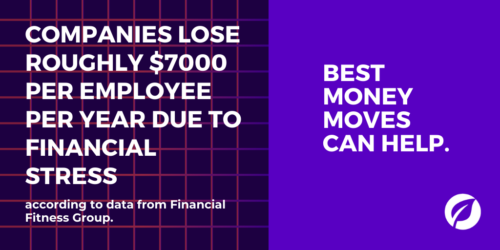
According to Financial Fitness Group, companies lose roughly $7,000 per employee per year due to stress caused by personal finance issues. And for employees, the effects of stress go far beyond dollars and cents. Long-term financial stress can take a huge toll on overall employee wellness and can even lead to emotional and physical consequences. 

Here are 4 ways that financial stress impacts overall employee wellness.

cost of financial stress

1. Financial stress can keep your employees up at night.

A good night’s sleep is important for both physical and mental health. A full night’s sleep has been linked to boosting the immune system, brightening mood, improving memory and even increasing day-to-day productivity. Unfortunately, those who are financially stressed are among the worst sleepers in America, according to the Better Sleep Council’s State of America’s Sleep survey.

Without healthy sleeping habits, an employee is more likely to experience mental strain, anxiety and depression, along with physical symptoms such as a weakened immune system. And those effects can spill over into the workday. According to the sleep foundation, sleep-deprived employees take more time to react in critical situations and are more likely to make mistakes than their well-rested counterparts. Reducing the financial stress that’s keeping your employees up at night is one step toward helping them rest easier.

2. Prolonged stress upsets employee work/life balance.

Proper work/life balance has already become a challenge following the COVID-19 pandemic, with millions of employees transitioning out of the office and into remote work. 

Burnout is a rising concern associated with stressed employees. Job burnout is a specific type of work-related stress that causes physical/emotional fatigue. Employees who suffer from significant levels of burnout can suffer from insomnia and increased stress levels and are more likely to take sick leave or look for another job. 

Employers can help their employees avoid burnout by creating a healthy workplace culture, allowing employees to work on a flexible schedule, and providing resources to address mental health concerns. Burnout remains a rampant problem in the workplace as, according to Deloitte, 77% of professionals have felt burnout at their current job.

3. Financial stress is a physical problem too.

Stress not only raises anxiety levels, but it can also take a physical toll on the body, causing high blood pressure, headaches, fatigue, pains and aches among other things. 

If the problem persists, stressed employees are more likely to get cardiovascular disease and other ailments that wind up killing around 120,000 people per year. Reducing that kind of stress in the workplace can avoid a cycle of various stressors that poor financial habits can cause.

4. Stress could be harming your workplace culture.

According to the Mayo Clinic, some of the most common effects of stress include increased irritability or anger. Employees burdened by stress are nine times more likely to have troubled relationships with coworkers and twice as likely to be searching for a new job.

It’s vital to address employee stress to foster a positive workplace culture  — one that allows employees to ask for personal finance assistance when they need it. One solution is to offer your team a financial wellness program. Providing employees with comprehensive financial wellness tools can help them address their financial stress head-on Plus, it signals to your employees that you care about their overall wellbeing.

Offer your employees relief from financial stress with Best Money Moves.

Less than 33% of workers have access to benefits that can assist with their financial needs according to a Financial Health Network survey. 

By offering financial wellness programs, like Best Money Moves, employers can help employees manage their personal finance goals and stress. 

Best Money Moves is a mobile-first platform that offers personalized financial planning and coaching resources, focused on solving your employees’ pain points. The program uses artificial intelligence, along with a human-centered design, to measure employee financial stress and then dial it down with personalized solutions. Our triggers and alerts system — as well as budgeting tools, personal finance resources and more — help guide employees to make more informed financial decisions and reduce their overall stress.

To learn more about Best Money Moves Financial Wellness Platform, let’s schedule a call. Contact us and we’ll reach out to you soon.